Niti Bhan

Lovingly made by human mind and hands

Menu
  • Home
  • About
  • Blog
  • Publications
  • Design Research
  • Contact
Menu

Tag: climate

Why ‘Design Thinking Sprints’ Won’t Work for Climate Adaptation Solutions

Posted on November 26, 2026November 27, 2026 by Niti Bhan

Ziervogel, G., Perumal, L., & Taylor, A. (2026). Applying design thinking for innovative climate adaptation solutions: Building capacity for locally led adaptation. Environmental Science & Policy, 184, 104481.

Almost from the start of my doctoral studies, I have appreciated the work of Dr Gina Ziervogel and her co-author teams. Ten years ago, for instance, Ziervogel et al. (2016) developed a three-pronged visualization of transformative capacity, in particular amongst low socioeconomic groups in urban South Africa. Today’s reflective review considers Ziervogel’s latest research, published last month (Ziervogel, Perumal, & Taylor 2026), which uses the popular understanding of ‘design thinking’ as a lens for convening and assessing multi-stakeholder collaborations for problem navigaton and solution development of ‘locally led adapation’ (LLA) to climate change. For the empirical component of their study, Ziervogel et al. (2026) collaborated with “the Hasso Plattner School of Design Thinking (d-school Afrika) and the Bertha Centre for Innovation & Entrepreneurship, all at University of Cape Town (UCT)” (p.2). I bring this to your notice because it identifies the flavour of design thinking referred to by Ziervogel et al. (2026), and is important for us to distinguish from the general usage of the two words together to refer to the way designers’ think (see Cross 2001). We will discuss its limitations later on against the backdrop of Ziervogel et al.’s (2026) own findings.

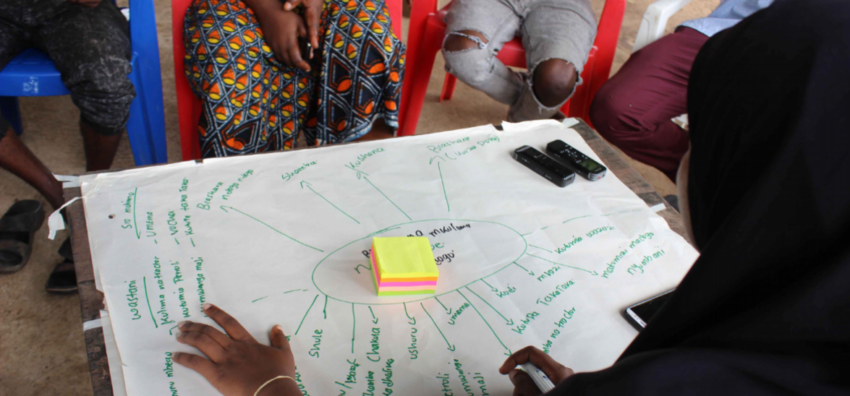
Four teams were convened after review and selection by Ziervogel et al. (2026) to participate in a 5 day design thinking sprint after a Phase 1 comprising a preparatory session and a systems thinking workshop. Phase 2 was the 5 day sprint based on the 5 stage process which comprises this popular version of design thinking as promoted by the d.schools. There was a Phase 3 for converting the concept-models into viable and feasible prototypes for real world implementation which finally did not occur. Thus Ziervogel et al. (2026) are only able to share their findings from implementing Phase 1 and 2. It is their findings which are of most interest to us as designers and planners of co-creation initiatives with multi-stakeholder groups in such multi-epistemological settings. I collapse their detailed and fascinating findings from the reflexive diaries of each team and their experience of the sprint into one key observation as captured by this longish extract from the discussion section (Ziervogel et al. 2026:6):

From the findings across the four teams, it is evident that challenge-led, facilitated design thinking does shift climate adaptation planning into a more targeted mode of tailoring prospective interventions to the nuances of individual situations and everyday lived-realities in local contexts. However, the process of getting teams through the stages of storming, norming and performing together to shift their thinking on the problem, formulate, test and potentially let go of preconceived notions of what can work, co-create alternative options, and refine them to a point that they can be validated by users and pitched to prospective investors, takes more time, support and iterative engagement than the design thinking sprint format allowed. While strong connections were made and various outcomes were sparked, on the whole teams were not yet adequately equipped to take the prototyped solutions forward outside of the programme. (Ziervogel et al. 2026:6, my emphasis added)

Sprints are fun but a closer look at the design of the 5 day sprint reveals a number of issues Continue reading “Why ‘Design Thinking Sprints’ Won’t Work for Climate Adaptation Solutions”
Confronting the “one size fits all” approach to research

Posted on November 19, 2026November 27, 2026 by Niti Bhan

Obaa Akua Konadu-Osei is rapidly becoming one of my favourite scholars to cite (Konadu-Osei 2026). Her scholarship peppers my own doctoral thesis as her observations, insights, findings, and arguments are irresistable. Here today I will focus on a Conversation piece she wrote to introduce the work done on business ethics research in non-western contexts (Konadu-Osei, O. A., Boroş, S., & Bosch, A. 2023).

Many academic studies have been centred on Western theories and methodologies for a long time. This approach to research is broadly defined as “universalist”. It assumes that “one-size-fits-all” and set norms can be applied across cultures. For example, Western ideas about identity revolve around the individual. That shapes how research is conducted: it focuses mainly on the individual and emphasises analysis at the individual level. Using Western approaches in non-Western contexts misses out on contextual issues such as power relations between an individual and their community. (Konadu-Osei 2022)

This reminds me of Yaw Ofosu-Asare’s (2026) recent paper in Designing journal. He writes on exactly this matter of concern by pointing out the difference in ontologies which underpin Western design theory and African design and its philosophical foundations. Theories built on an ontology predicated on the individual will very obviously be incommensurable by ontologies predicated on the collective. The very notion of authorship and agency changes significantly depending on your underlying set of assumptions and the philosophical foundations in which they are rooted, regardless of whether you are cognizant of these or not, as Ofosu-Asare (2026) explains to us, using African philosophy as his ground for argument thus:

If personhood is fundamentally relational, even in the moderate communitarian sense that Gyekye argues, then the figure of the designer as isolated author, sovereign creator, and proprietary owner becomes philosophically incoherent. Much of Western design theory assumes precisely such a subject. Western design theory then encounters collective, distributed, or socially embedded forms of making and names them informal, unstructured, or pre-professional. The encounter is with a different ontology of agency. (Ofosu-Asare 2026:240)

” In strict disciplinary terms, these are philosophical texts; their implications for any philosophy of making, authorship, agency, and collective life are profound” (Ofosu-Asare 2026:240). This is key. Not only do “one size fits all” methodologies and epistemologies fall short in practice, or worse, extract only what they think they need and discard the rest but this approach inherently retains all epistemic authority within the hegemonic knowledge system of the academy. Here I want to share a diagram (Figure 2, p. 241) from Ofosu-Asare’s (2026) article whose aim is to dismantle the putative inclusivity of the pluriverse as a notion by confronting the philosophical grounds for its arguments. Continue reading “Confronting the “one size fits all” approach to research”

User Expectations From Climate Services Design

Posted on November 18, 2026November 27, 2026 by Niti Bhan

Biella, R., Brandimarte, L., Mazzoleni, M., & Di Baldassarre, G. (2026). Form over Function: How design expectations shape what counts as a climate service. Climate Services, 43, 100674.

Breaking: Scientists discover a clear bias towards form and function amongst users of climate services!

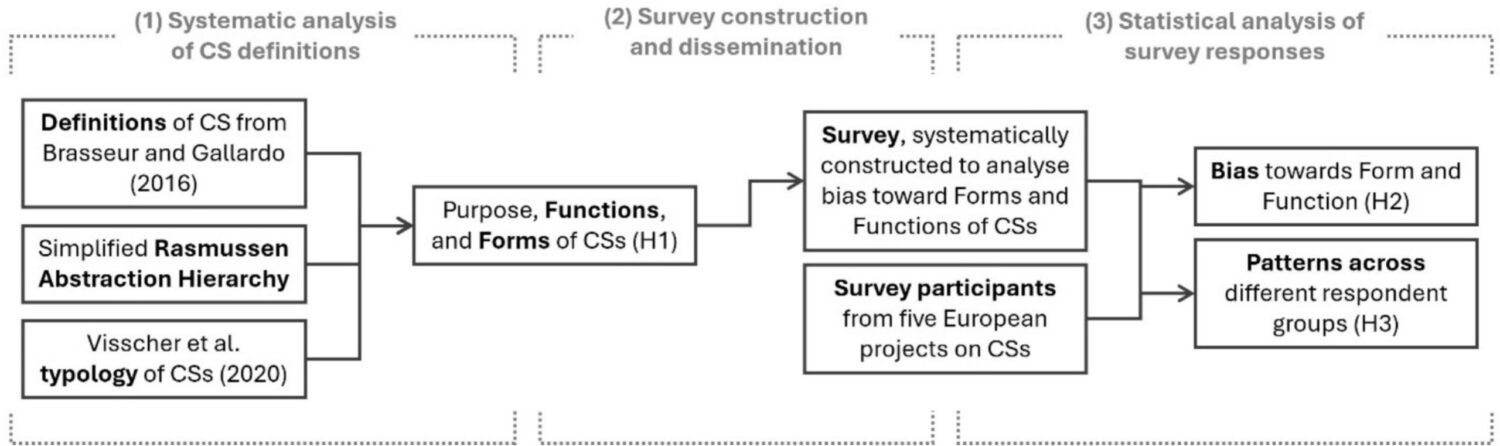
As the author of an experienced designer’s late career doctoral thesis on epistemologically-sensitive service design, the recent turn towards design-infused research studies from inter-disciplinary teams of climate scientists is undeniably an encouraging development. Earlier, I had reviewed the work of Holden et al. (2026) whose mixed methods study across 5 African countries comprising 530 interviews of end-users revealed a significant gap in user needs which remains unfulfilled due to a lack of meta-theoretical scaffolding at the whole knowledge systems level. Now, I take a closer look at Biella et al. (2026) who, as recently as August this year, published findings from their “survey of researchers, developers/providers, and practitioners involved in European climate-service initiatives” (p. 1). Climate Services users bias towards Form and Function is the hypothesis that Biella et al. (2026) test in their study as illustrated by their methodological diagram below.

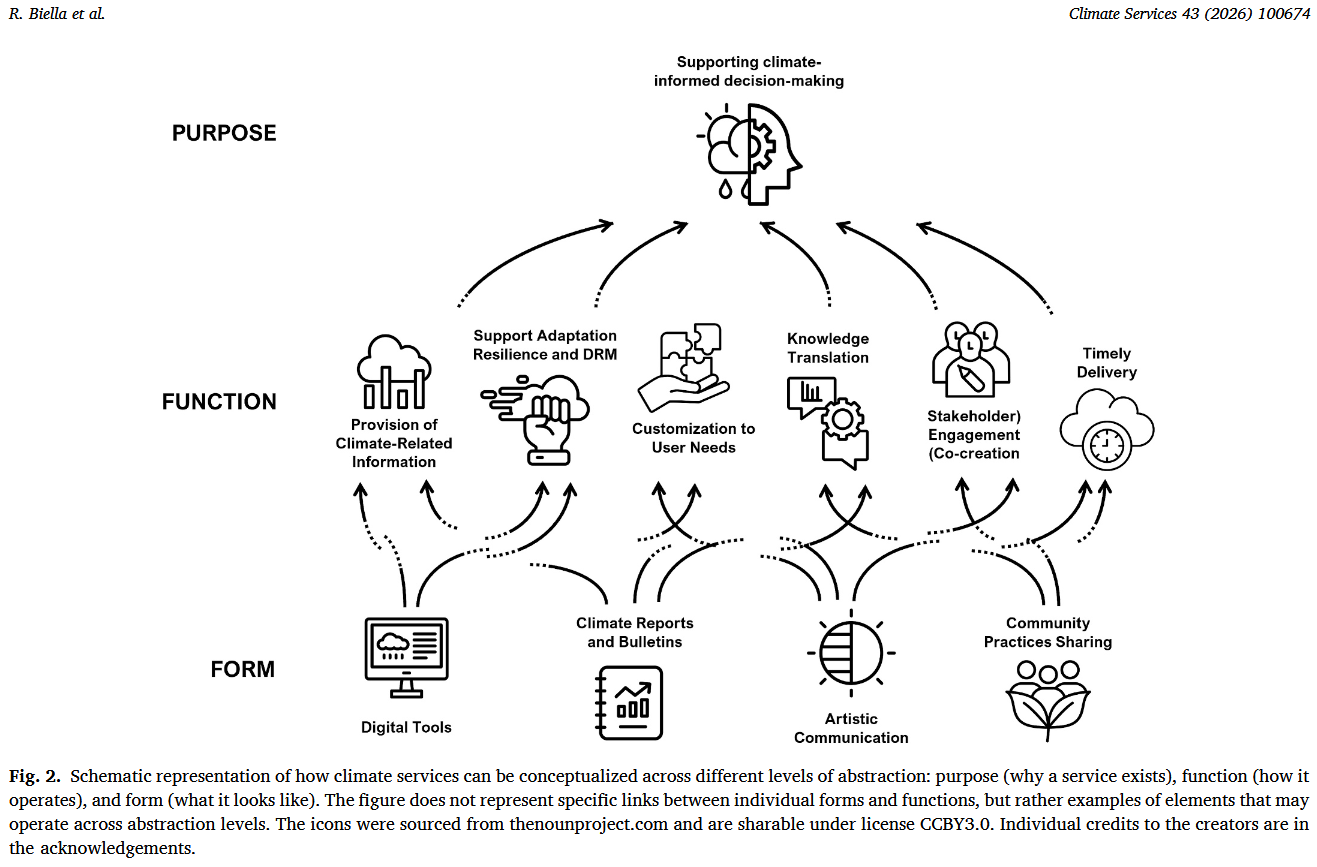
What is also interesting to note is that this study focused on European climate-service initiatives while Holden et al. (2026) studied African ones. That is, we are slowly able to build a knowledge base of actionable design insights being acquired systematically (“research”) by scientists from a diverse range of users. In fact, as I review Biella et al. (2026) right now, it strikes me that all of these interdisciplinary teams of climate scientists are generating a deep well of design knowledge on Users & Context for climate services. This illustration from Biella et al. (2026:7, Figure 2) for example clearly speaks design language. I have taken a screenshot from teh article in order to include the citation and the caption as written by them (Biella et al. 2026:7).

Few designers will argue that such a diagram, generated after a scientifically grounded study, does not provide insights for design planning and design strategy for preparing work on climate services design. This really is my biggest takeaway from science; teams of scientists are making extremely valuable contributions to design and co-creation projects. It make me wonder what it is that human-centric design can contribute in return to such planetary design initiatives.

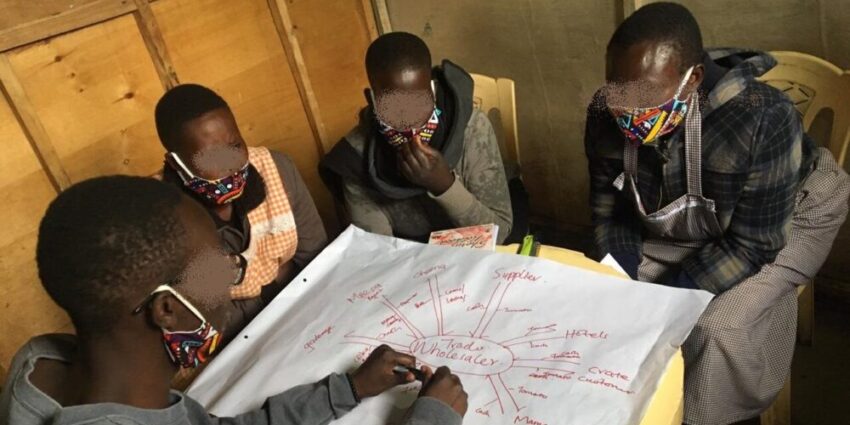
Featured Image Credit: Team Tazama Africa, July 2020 during one of the three empirical studies which support my doctoral thesis.

Horizontal portability of relational values

Posted on November 13, 2026November 27, 2026 by Niti Bhan

Himes, A. et al. (2025). Horizontal portability: a proposal for representing place‐based relational values in research and policy. People and Nature, 7(4), 752-764.

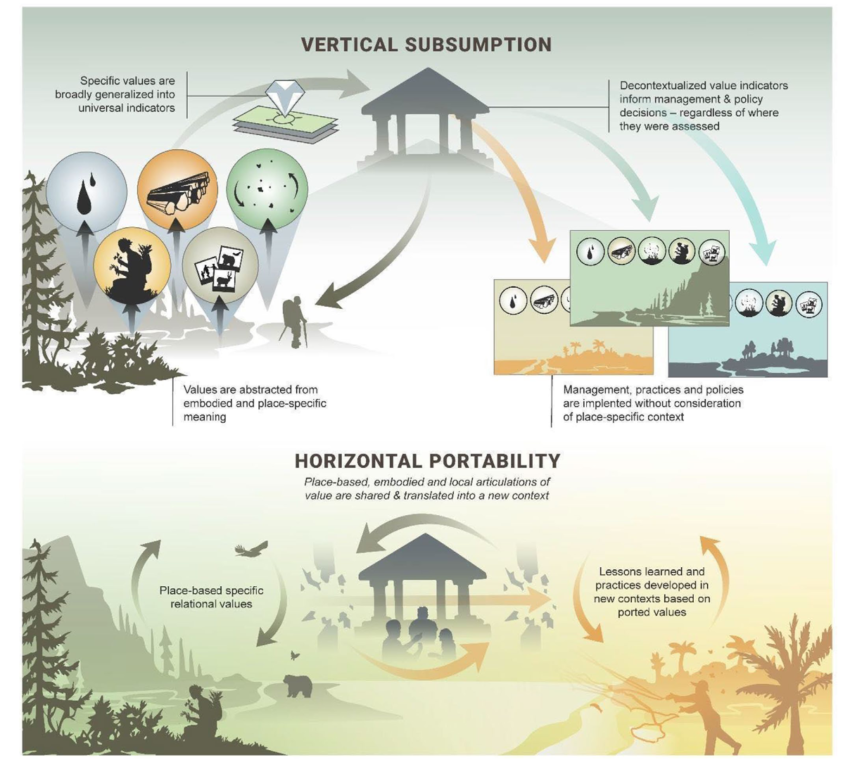
Humankind’s relationship with nature and the web of life – their relational values – are particular to a place and a setting. Himes et al. (2025) argue that simply extracting generalities from such axiological studies and then applying them elsewhere does not work. They call this vertical subsumption, as seen in the featured image above. Instead, they suggest ‘horizontal portability’ (Himes et al. 2025) for just, equitable, and plural axiologies. The implications of recognizing and applying the notion of value pluralism (Himes et al. 2024:36) are significant for planning and implementing co-creation projects with multiple knowledge systems (Bhan, forthcoming).

When Whanganui Iwi (Māori) people declare of the Tupua River, ‘I am the River and the River is me’ (Tupua Whanganui River Claims Settlement Act, 2017) it is clear that the relational value of the river cannot be replaced by anything else and that the cultural and ecological components of a place and the people that belong to it are not easily separable. (Himes et al. 2025:753)

According to Himes et al. (2025), relational values are incommensurable with compensation or substitution, such as the loss of a trusted friend. You may make other friends who may also be as closely beloved but they can never replace the friend who was lost. Thus the same applies to humankind’s relationships with nature, being deeply rooted to a place, community, and sense of belonging, contributing to one’s own identity. “Relational values are more often associated—in comparison to other value types—with a ‘context-specific perspective’, which suggests that they lose meaning when separated from their specific biocultural context” say Himes et al. (2025), who “refer to them in terms of place-based relational values” often contituting “the collective identity of local communities” (p. 753). For human-centric design research undertaken for project information development (sometimes called user research, see Bhan & Tedjokusumo 2025), understanding users’ values is crucial for co-creation of efficacious public services (see Bhan & Rytilahti 2026).

Elucidating place-based relational values is essential to accurately representing the valuers’ direct experiences and understanding, as well as their unique relationships with, and knowledge of specific places. (Himes et al. 2025:753)

Continue reading “Horizontal portability of relational values”

Why user needs in climate services design remain unfulfilled

Posted on October 29, 2026November 27, 2026 by Niti Bhan

Holden et al. (2026) recently published very interesting findings in Nature Climate Action and I find they support the arguments I make in my thesis (albeit from a different angle). They “investigate the relationship between users’ current climate-service use and desired needs for completely new climate services for nature-based solutions in Sub-Saharan Africa, based on 530 interviews” (Holden et al. 2026) of people involved in nature-based projects in Ghana, Kenya, Tanzania, Madagascar and South Africa. For the purpose of this excited blog post, I’ll use the Conversation piece written by 4 members of the large author team to popularize their research. What is most interesting, from the service design point of view, is their conclusion:

Simply asking people what climate information they need is not enough. Scientists, providers, users and local and Indigenous knowledge holders need the time, resources and incentives to develop climate services together. (Holden et al. 2026)

That is, simply eliciting user needs is not enough. Co-creation is required, and, most importantly, climate services must be co-created with multiple knowledge systems if they are to be truly useful to the end-users. Nature-based solutions cannot rely only on modern western science but must find ways to collaborate with the indigenous, local, traditional knowledges of the setting.

More than 80% said existing climate services had limitations. One major problem was that Indigenous and local knowledge forecasting or decision making was not connected to formal climate services. For example, in Turkana, Kenya, traditional seers known as Emuron use Indigenous practices to anticipate severe weather and other climate disasters. Elders also send scouts to assess pasture and water before deciding where livestock should move. But these practices are not connected to formal climate services. (Holden et al. 2026)

I see this as a service design challenge, and one which the dominant knowledge system may not be in a position to fulfill. Here, the missing component of ‘user needs’ is not ‘needs’ per se so much as it is the knowledge of the users themselves which is needed. How might we co-create services with multiple knowledge systems?  It is this challenge I address, as a designer and researcher, in my doctoral thesis, beginning with upfront user research for planning and design of just and equitable co-creation interfaces for such public service projects. From my perspective as a professional design researcher, Holden et al. (2026) conducted valuable user research amongst 530 users of climate services in multi-epistemological settings where local, traditional, and indigenous knowledge systems can be expected. Clearly, to find scholarship which pinpoints the exact challenge I chose to focus on as one which remains unfulfilled is exciting.

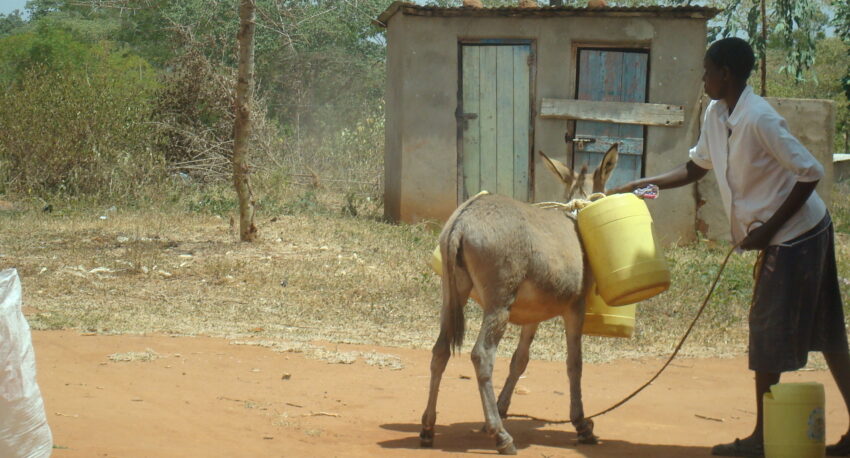
Featured image: A photograph of the water supply system in an arid region of Kenya, taken by Niti Bhan in October 2011. 

Africa assumptions axiology blindspot climate climate adaptation climate change climate services climate services design co-creation collective creativity design design exhibition design methodology design research design research methodology design sprint fails facilitation fuzzy front-end horizontal portability human-nature relationship informal economy innovation knowledge systems majority world markets mass production meta-research Mexico mobile phones mobile telephony nature-centric design one size fits all ontology pluralism prepaid economy project planning reflexive review relational values smartphones user inquiry user needs user research user values UX research vertical subsumption

  • Axiology
  • Co-Creation
  • Design
  • Long Read
  • Marginalia
  • Perspective
  • Playground of the mind
  • Reflexive Reviews
  • Research
  • Strategy
  • November 2026
  • October 2026

Business Registration

Emerging Futures Lab

Y-Tunnus 2607854-3

Ymmärrys ry

Y-Tunnus 3288926-2

.

Design Research Services

Lorem Ipsum

©2026 Niti Bhan