Obaa Akua Konadu-Osei is rapidly becoming one of my favourite scholars to cite (Konadu-Osei 2026). Her scholarship peppers my own doctoral thesis as her observations, insights, findings, and arguments are irresistable. Here today I will focus on a Conversation piece she wrote to introduce the work done on business ethics research in non-western contexts (Konadu-Osei, O. A., Boroş, S., & Bosch, A. 2023).
Many academic studies have been centred on Western theories and methodologies for a long time. This approach to research is broadly defined as “universalist”. It assumes that “one-size-fits-all” and set norms can be applied across cultures. For example, Western ideas about identity revolve around the individual. That shapes how research is conducted: it focuses mainly on the individual and emphasises analysis at the individual level. Using Western approaches in non-Western contexts misses out on contextual issues such as power relations between an individual and their community. (Konadu-Osei 2022)
This reminds me of Yaw Ofosu-Asare’s (2026) recent paper in Designing journal. He writes on exactly this matter of concern by pointing out the difference in ontologies which underpin Western design theory and African design and its philosophical foundations. Theories built on an ontology predicated on the individual will very obviously be incommensurable by ontologies predicated on the collective. The very notion of authorship and agency changes significantly depending on your underlying set of assumptions and the philosophical foundations in which they are rooted, regardless of whether you are cognizant of these or not, as Ofosu-Asare (2026) explains to us, using African philosophy as his ground for argument thus:
If personhood is fundamentally relational, even in the moderate communitarian sense that Gyekye argues, then the figure of the designer as isolated author, sovereign creator, and proprietary owner becomes philosophically incoherent. Much of Western design theory assumes precisely such a subject. Western design theory then encounters collective, distributed, or socially embedded forms of making and names them informal, unstructured, or pre-professional. The encounter is with a different ontology of agency. (Ofosu-Asare 2026:240)
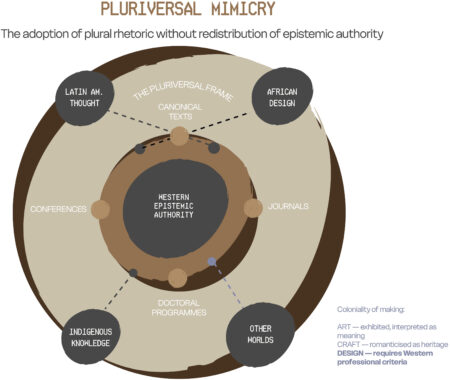
” In strict disciplinary terms, these are philosophical texts; their implications for any philosophy of making, authorship, agency, and collective life are profound” (Ofosu-Asare 2026:240). This is key. Not only do “one size fits all” methodologies and epistemologies fall short in practice, or worse, extract only what they think they need and discard the rest but this approach inherently retains all epistemic authority within the hegemonic knowledge system of the academy. Here I want to share a diagram (Figure 2, p. 241) from Ofosu-Asare’s (2026) article whose aim is to dismantle the putative inclusivity of the pluriverse as a notion by confronting the philosophical grounds for its arguments.
Against this backdrop of the control over epistemic authority (Ofosu-Asare 2026), we can see the limitations of Western knowledge practices identified as gaps for business ethics research in the same (or similar settings) by Konadu-Osei et al. (2023). They closely examined the epistemological and methodological infrastructure available to them (“Western Knowledge System” or “WKS”, used as heuristic device) to pinpoint epistemological blindspots once these research practices were extended to settings they were never designed for (or, as many Indigenous scholars will argue, were designed to ignore, invisibilize, or otherwise erase from view).
Konadu-Osei et al. (2023) incorporate ubuntu into their research methodology to build bridges at the cultural interface (Nakata 2007) where multiple knowledge systems bring together their own ontologies, axiologies, and epistemologies. I, on the other hand, chose to work on the question of whether design research methodologies could be reworked to illuminate these same epistemological blindspots which are the focus of both Ofosu-Asare’s (2026) and Konadu-Osei’s (2026) work. Regardless of our respective focii, what we are all working on can be very simply described in one word as pluralism, rather than universalism. One size does not fit all.