Niti Bhan

Lovingly made by human mind and hands

Menu
  • Home
  • About
  • Blog
  • Publications
  • Design Research
  • Contact
Menu

Category: Perspective

Building Bridges From Prototype to Production

Posted on October 23, 2026October 24, 2026 by Niti Bhan

Reading “Bauhaus and Mass Production” on the Bauhausian digital platform makes me want to add some of my thoughts on the gap the author identifies as seminal to understanding the legacy of the Bauhaus.

The Bauhaus was a laboratory for industrial design, but laboratories generate failed experiments as well as successful transfers. Its most useful story is not that it solved mass production. It learned to design for the possibility of reproduction—and then encountered the economic realities that determined whether reproduction actually happened. (Bauhausian.com, n.d.)

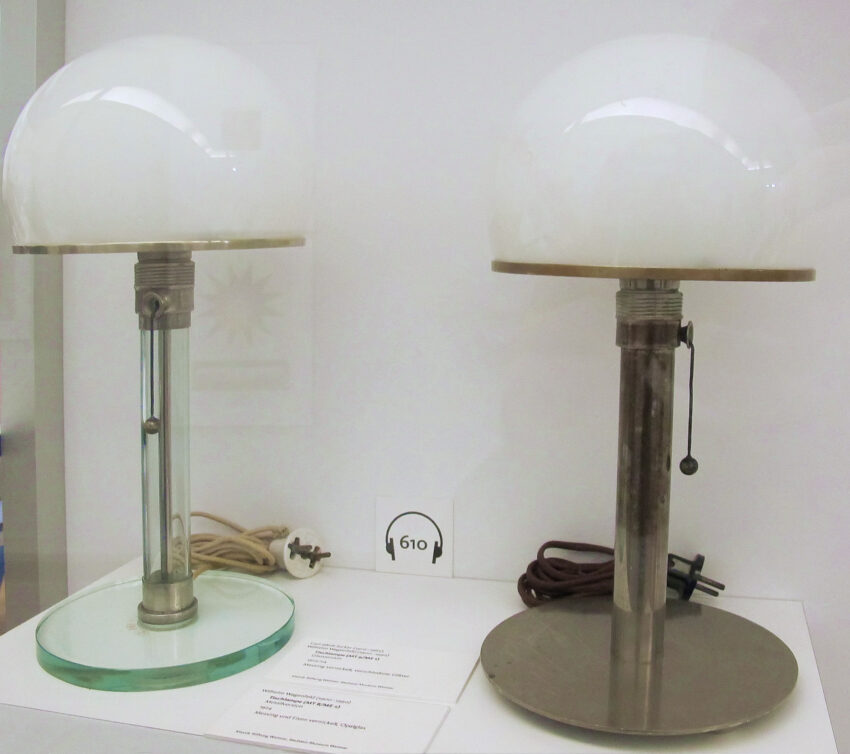
The Bauhaus aimed to build bridges between the materials of industrial production and the craft of design as they experimented with new ways to manipulate new materials (steel tubes, for example). The bridge being built here was industrial design purposefully aimed at the needs of mass production, as the author points out above. That is, a bridge between design and engineering. What was missing here was business (“economic realities”), the third leg of innovation. That would arrive as its own set of design constraints many decades later.

The German Bauhaus … represents an important and significant endeavor toward devising both a general definition of design and a method of design education in the twentieth century. Although … the Bauhaus was closed in 1933, it was to be reborn in 1937 in Chicago under the name of the New Bauhaus. (Findeli 1990:4)

As Findeli (1990) describes, circumstances led to Moholy-Nagy (the German Bauhaus teacher who founded the Chicago school) being requested to “reorient its pedagogical program to bring it more in line with the priorities of Chicago’s skeptical businessmen” (p. 6). That is, the foundation of the design + engineering orientation to prepare industrial designers for mass manufacture which the German Bauhaus is recognized to have established (Bauhausian.com, n.d) came to America where it was encouraged to confront commercialization in earnest (Findeli 1990). In effect, the original blend of design + engineering was now being asked to shake hands with business.

This means that the statement, “form follows function,” has to be supplemented; that is, form also follows – or at least it should follow – existing scientific, technical and artistic developments, including sociology and economy.“‘ (Findeli 1990:10 citing Moholy-Nagy, emphasis added)

Findeli (1990) does not pursue that little snippet I emphasize in the quote above any further in his paper, which instead focuses on design pedagogy and its philosophical foundation as developed by Moholy-Nagy. It is here that I will have to jump forward in time another number of decades to arrive at the point where we have come to take for granted that a blend of design, engineering, and business is the expected knowledge-base of professionals working at the very front-end of product development.

Continue reading “Building Bridges From Prototype to Production”
Does a chatbot dream of research paradigms?

Posted on October 22, 2026October 22, 2026 by Niti Bhan

Weber, J., & Prietl, B. (2022). AI in the age of technoscience: On the rise of data-driven AI and its epistem-ontological foundations. In The Routledge Social Science Handbook of AI (pp. 58-73). Routledge. 

As I engaged with the meta-theoretical foundations of knowledge-making for scaffolding methodological development in my doctoral thesis, I increasingly began wondering what were the underlying set of assumptions (called inquiry paradigm by Lincoln & Guba 1995, 2005; also research paradigm, Pretorius 2024) which informs knowledge products spat out of a machine in response to a prompt. The dimensions of these ‘sets of assumptions’ are recognized as epistemology (the nature of knowledge), ontology (the nature of reality), axiology (the nature of values) in addition to methodology which together encapsulate a ‘research paradigm’; it lays the foundation for any systematic program of knowledge-making. Here, in the age of generative AI, when pop-ups in academic publishers’ websites offer to ‘make sense’ of the article you clicked on, it raises the question: what are the assumptions on knowledge and reality and values which underlie the knowledge product constructed by a machine? What is it’s research paradigm? How might I navigate any incommensurabilities between it’s assumptions and mine? Or, is the legacy dominance of positivism being imposed on us, regardless of our own paradigmatic preferences (e.g. constructivism or pragmatism) simply as a result of using past data to predict future content?

The book chapter I link to here by Jutta Weber and Bianca Prietl offers me some answers to these questions; and, in a way, confirms my worst case scenario. Continue reading “Does a chatbot dream of research paradigms?”

There is a new lens by which I can see

Posted on October 16, 2026October 17, 2026 by Niti Bhan

I was taken by surprise today as I reviewed a couple of links I’d bookmarked to return to after my manuscript revision was complete. In the first, blogged on The Prepaid Economy blog, I suddenly found myself noticing that the work done over the past 20 years on the informal economy was, in fact, a means to ‘dismantle the monolith’. Here, the monolith is clearly that of an undifferentiated and unsegmented mass of peoples lumped together under easy-to-use labels such as “informal sector” or “bottom of the pyramid” which collapse all diversity, heterogeneity, and plurality into the convenience of one single lens by which to call them all. Four (4) billion peoples live on “$2 a day” and lost all other distinction not to mention individuality when they became “the BoP”. The informal economy does not even get this discretionary cash flow as a distinguishing factor. All of it around the world is relegated to the shadows, outside the lines clearly drawn for “formality”. It struck me then, as I pointed out how this most recent research (by the OECD) is the first I’ve seen which explicitly states what we’ve been saying for 20 years: One size does not fit all. In order to dismantle this monolithic view predicated on grand challenge scales (“the next billion” as the target “user” for planning design actions), one must unpack the patterns of financial behaviour at the level of first principles in order to construct models to segment that which cannot be predicted.

I’ll come back to this later, here I want to move on to the second link I reviewed this morning, one on community environmental behaviour observed during a South African research study in a rural community. Empirical data contradicts dominant narratives which assume financial incentives will be required for the poor to involve themselves with sustainability. Interestingly however, what they found was community actions on climate change adaptations were motivated by ‘ubuntu’, the Southern African philosophy predicated on kinship and relationality.

A long-standing idea in environmental research is that people are more likely to care about the environment, and do something to prevent environmental damage, once they earn enough to stop worrying about paying their bills. But what happens in rural communities with high levels of poverty, where money is scarce and environmental changes directly affect people’s livelihoods? We are economists who wanted to find out what explained environmental action best: income levels, or the strength of people’s connections to their fellow community members (Kirsten & Biyase 2026)

A relational viewpoint is revealed by the link between actions taken and the ‘strength of people’s connections” (Kirsten & Biyase 2026). The stronger the relationality, the more likely the community would take actions which would benefit all and future generations. The ‘long-standing idea’ which Kirsten & Biyase (2026) overturn with empirical evidence is an assumption in their line of work which can be problematized, as they have done. It is the result of taking a ‘rational’ viewpoint which rooted in positivism and the scientific method. Recognizing this, too, I now realize, is part of ‘dismantling the monolith’ since relational viewpoints, such as those illuminated by Kirsten & Biyase (2026) are closely identified with indigenous research paradigms, underpinning the relational axiology of indigenous knowledge systems (Chilisa 2019). There is much more to be said here but I will stake a step back instead to consider both the links and my response to them.

I can see clearly a nuanced shift in my interpretation and understanding. It is also clear that it results from the work done over these past 6 or 7 months on constructing a (meta) theoretical and conceptual frame for my doctoral research. Here now, I will pause reflexive analysis and pick it up again once I have materials to share in public. Suffice to say, I did not expect this. And must ponder its implications.

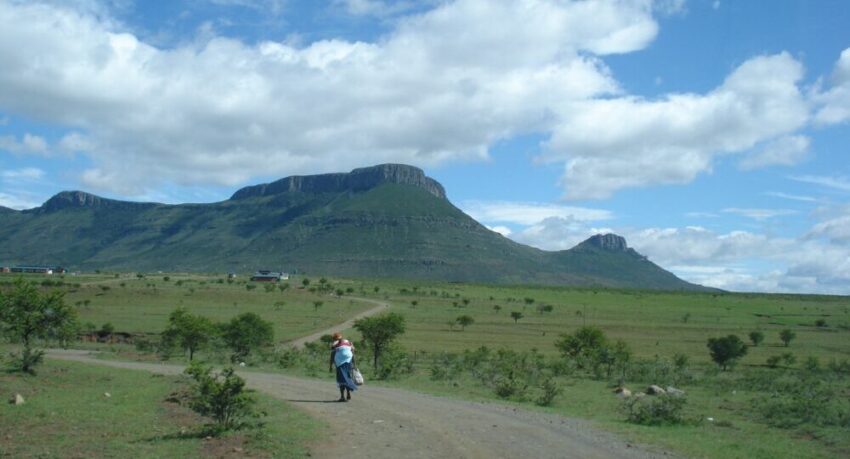
Photo taken by Niti Bhan, Eastern Cape, South Africa, January 2008

Playgrounds of the mind

Posted on October 15, 2026October 17, 2026 by Niti Bhan

They say, in the department, that nobody ever reads the synopsis (also called exegesis or kappa) except the examiners. So I followed the standard template assiduously. And failed spectacularly. Oh, I had original contributions to make, my examiners were convinced, but my presentation of my dissertation research was not only not accepted for publication (and hence public defence) but the decision agreed by all was that this was a major revision. Not a minor one. Not a moderate one. Not an outright rejection either. Nope. It was ‘go back and do it all over again’.

So I did.

As I sit here now, less than a week after sending it in again for re-examination, I can only think that this decision was the best thing that ever happened to me in my doctoral journey. A major revision comes with ample time to think, to review, to revise, and to rewrite. The committee offers you 12 months for delivery. I aimed for 3, then aspired to finish in 6 but by the time the myriad little details were all worked out and last minute corrections shoved in, it was almost 7 months before it was ready to go public. I hope my examiners haven’t forgotten me, I’ve been in my cave for so long.

This time I wrote something that wanted to be read. Its a nuanced difference, but I think an important one for me.

I now approached it as the public dissemination of academic scholarship as a doctoral candidate of a university whose birth I remember. Whose reveal party I attended in September 2007; whose prototype I toured in September 2008; and whose research community I joined in September 2019. Yet, interestingly, no matter how often I look back over almost 20 years of involvement, I cannot find any evidence that I could have ever produced anything of this quality and positionality had I begun writing my doctoral thesis any earlier than this time of life.

That is, this is not the dissertation of what is commonly known as “an early career researcher” although technically, according to the formal academic definition, that is exactly what I am at this grand old age of 60. I remember telling someone I’m not “early career” anything at this point. On one hand, as my publications show, I have only a handful of peer reviewed scientific research articles; a popular way to assess the relative “earliness” of a researcher’s career. On the other hand, I have more than 10 commissioned research reports and a track record of funded research projects going back the same 20 years. Its complicated, she said.

For now I will use the status of ‘Independent Researcher’. Its a good enough at this moment in time. I have built reputations, brands, and careers over the past 36 years. Now, I will undergo my own major revision; in no small thanks to the fatal crash of this website.

It opens a new question: What do I want to build next?

This is an absolutely wonderful question. It motivates. It does not inspire. But, what it does is, leave open many possibilities and many searchways for inspiration. In the meantime, I have my blog up and running. And, that, perhaps, is the most important thing of all at transitional times like this.

Here be ‘playgrounds of the mind‘ (with apologies to Larry Niven)…

lovingly made by human mind and hands

Posted on October 15, 2026October 17, 2026 by Niti Bhan

What do I mean by “lovingly made by human mind and hands”?

This is a short note on the tagline in the header of this website. It was written in response to the preponderance of technologies used to generate and disseminate “content” once I realized that not only was I building this site by hand, as much as possible using the barest minimum of tools available for the back-end but that I would write each and every word by hand and mind.

Out there on the internet, blog and bulletin board conversations ponder the question whether its still worth keeping a blog in the age of gen AI. Interestingly, one of the most popular answers is that a blog offers a track record of thinking and writing. Only when I saw ‘How To’ guides on writing without the help of technology did I realize the trend now to recapture the early spirit of blogging from 25 years ago. And to re-establish the human voice and p2p communication.

I would rather put errors and typos out there than run my thoughts through a machine for perfecting. It is the same rule I followed for my entire doctoral thesis. And, it is the way I learnt to write more than 50 years ago. I don’t see why I need to give that up now.

So, this is a crude handmade object. Let’s see how it fares in today’s ‘online’ and then perhaps look back and compare with how things were 20+ years ago when this domain was established and the first blogpost launched.

To restore or not to restore?

Posted on October 14, 2026October 17, 2026 by Niti Bhan

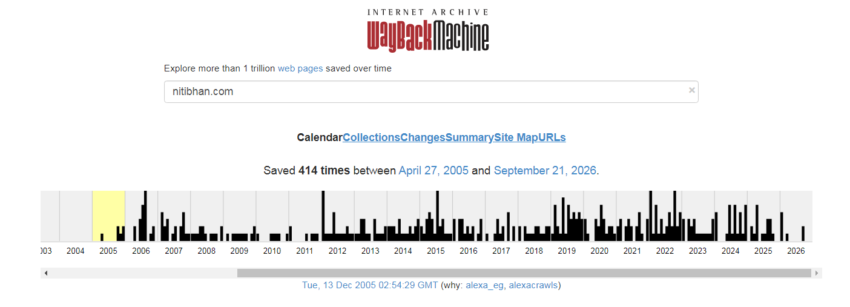
Some of you may have noticed that this site was down with a terminal error between 21 September 2026 and yesterday, 13 October 2026. Just enough time for it to disappear completely from search results. More than 20 years of blogging went *poof* and erased my legacy online. The link takes you back through the Wayback Machine links spanning April 2005 to September 2026.

Instead of being devastated at the thought of rebuilding my domain brick by brick or trying (unsuccessfully) to import the blogposts from the sidelined instance at the back end, I am curiously feeling unfettered and relieved.

I now have a wholly blank slate for the decision to be made. A decisive stage-gate moment which the crash makes easy to contemplate in a manner that would not have been possible if the lingering legacies of my years of writing were still flapping around in the wind like loose threads.

Let us assume for now that I am undergoing the process of decision-making. Blogposts may emerge from this process. I have no answers with which to close this post.

Hello world!

Posted on October 13, 2026October 14, 2026 by Niti Bhan

Welcome to WordPress. This is your first post. Edit or delete it, then start writing!

I’ve spent the day building a blogger’s home website from scratch. I’ve lost count how many times I’ve done this since my first foray into the “blogosphere” as we used to call it back in 2005. The old site crashed about a month ago but I was busy completing the major revision of my doctoral thesis which I just sent in for review by my external examiners.

It looks like the technicalities of why the site crashed are beyond repair.

So here I am, starting over on a blank page (as we used to say back when fountain pens had feathers) at the grand old age of 60. I point out that because I remember celebrating my 40th on this blog, a year after I first began Perspective, the blog. Will I name this blog Perspective once again?

This time I truly don’t know. Let’s see where it goes. At least for now, I will use my full name under which I’ve been publishing in peer reviewed scientific journals. But that’s a story for another day.

  • Co-Creation
  • Design
  • Long Read
  • Marginalia
  • Perspective
  • Playground of the mind
  • Reflexive Reviews
  • Research
  • October 2026

Africa blindspot climate change climate services co-creation commentary cultural interface design design exhibition design research epistemological pluralism ILTK indigenous epistemologies indigenous knowledge JDE Jorge Diego Etienne local local knowledge meta-research Mexico Museo Franz Mayer nature-based projects observation plurality project planning research paradigms service design traditional user research UX research

Business Registration

Emerging Futures Lab

Y-Tunnus 2607854-3

Ymmärrys ry

Y-Tunnus 3288926-2

.

Design Research Services

Lorem Ipsum

©2026 Niti Bhan