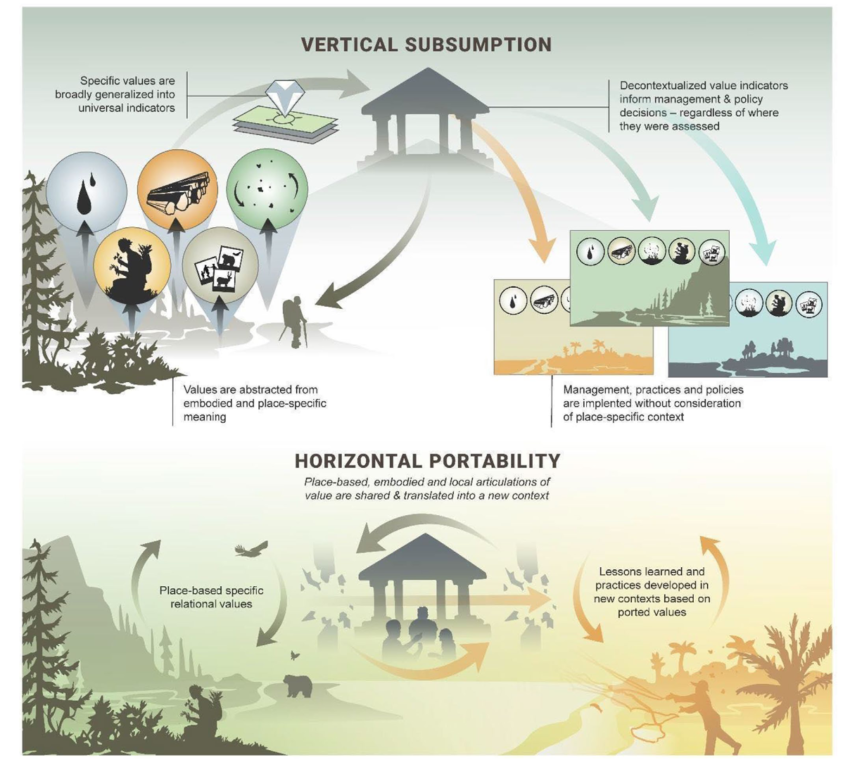
Himes, A. et al. (2025). Horizontal portability: a proposal for representing place‐based relational values in research and policy. People and Nature, 7(4), 752-764.
Humankind’s relationship with nature and the web of life – their relational values – are particular to a place and a setting. Himes et al. (2025) argue that simply extracting generalities from such axiological studies and then applying them elsewhere does not work. They call this vertical subsumption, as seen in the featured image above. Instead, they suggest ‘horizontal portability’ (Himes et al. 2025) for just, equitable, and plural axiologies. The implications of recognizing and applying the notion of value pluralism (Himes et al. 2024:36) are significant for planning and implementing co-creation projects with multiple knowledge systems (Bhan, forthcoming).
When Whanganui Iwi (Māori) people declare of the Tupua River, ‘I am the River and the River is me’ (Tupua Whanganui River Claims Settlement Act, 2017) it is clear that the relational value of the river cannot be replaced by anything else and that the cultural and ecological components of a place and the people that belong to it are not easily separable. (Himes et al. 2025:753)
According to Himes et al. (2025), relational values are incommensurable with compensation or substitution, such as the loss of a trusted friend. You may make other friends who may also be as closely beloved but they can never replace the friend who was lost. Thus the same applies to humankind’s relationships with nature, being deeply rooted to a place, community, and sense of belonging, contributing to one’s own identity. “Relational values are more often associated—in comparison to other value types—with a ‘context-specific perspective’, which suggests that they lose meaning when separated from their specific biocultural context” say Himes et al. (2025), who “refer to them in terms of place-based relational values” often contituting “the collective identity of local communities” (p. 753). For human-centric design research undertaken for project information development (sometimes called user research, see Bhan & Tedjokusumo 2025), understanding users’ values is crucial for co-creation of efficacious public services (see Bhan & Rytilahti 2026).
Elucidating place-based relational values is essential to accurately representing the valuers’ direct experiences and understanding, as well as their unique relationships with, and knowledge of specific places. (Himes et al. 2025:753)
Continue reading “Horizontal portability of relational values”