
Himes, A., & Muraca, B. (2018). Relational values: the key to pluralistic valuation of ecosystem services. Current Opinion in Environmental Sustainability, 35, 1-7.
Himes & Muraca (2018) construct a robust and well-constructed argument for relational values as a new category of value assessment. In particular, relational values are argued in support of humankind’s relationship with nature. Their argumentation is nuanced but worth the re-reading it takes to unpack the meaning. More so, when axiology as a whole is still considered an emerging strand of philosophy of science and was only recently incorporated as a dimension in its own right to be encapsulated in one’s research paradigms (Lincoln, Lynham, & Guba 2011).
We have to draw an important distinction between epistemic anthropocentrism, which means that knowledge and judgments are always human-centered and that valuations must come from a human perspective, and moral anthropocentrism, which states only humans are bearer of values and worthy of direct moral consideration. (Himes & Muraca 2018:3)
Elsewhere, I have seen Biedenbach & Jacobsson (2016) cited for a concise explanation of axiology. However, in their explication of value theory they have stopped at the classics: first, the distinction between intrinsic and instrumental value, which they state have been around since the days of Plato and Aristotle; and, much later, on this basis, their extension into three axiological dimensions viz., “intrinsic, extrinsic, and systemic values” (Biedenbach & Jacobsson 2016:140). The authors then proceed to elaborate on each of these three types of value, offering three different ways to value something (p. 141).
Now, how can ecological processes—defined as inherent to nature—be independent of human judgment or of ‘any human consideration of its worth and importance’, if they are articulated via scientific research, that is human research that assesses its ecological importance? (Himes & Muraca 2018:3)
I had paused there when reviewing Biedenbach & Jacobsson (2016), unable to articulate what it was which made me uncomfortable even though I completely agreed with their statement that “Central to philosophy of science—even if often disregarded—we thus have the core concepts of this article; in other words, axiology and value theory” (Biedenbach & Jacobsson 2016:140). It was only when I stumbled over Himes (I’ll be blogging on another of his team authored articles soon, its halfway done) and his work on relational forestry (Himes & Dues 2024) that my interest in exploring axiology from my own perspective as designer and researcher was resparked. With all due respect to Biedenbach & Jacobsson (2016) who have done important work on arguing for our values as they inform our research designs and plans to be made explicit, they were still colouring within the lines laid down multiple millennia ago. Their only addition is systemic, which in the scholarship they use (Hartman 2014, 1961) for interpretation, is a binary yes/no decision which aligns more closely with external systems design than with the inter-relationships between nodes in a system as we might otherwise interpret its meaning.
Instrumental, intrinsic, and non-instrumental relational values are distinct and not commensurable, but they are connected and can be simultaneously present [This typology of values corresponds to three different narratives viz.,] gaining from nature (instrumental), living for nature (intrinsic in the sense of the direct moral consideration of nonhuman subjects of a life), and living in nature (relational). (Himes & Muraca 2018:3)
Instead, it is Himes & Muraca (2018) who have opened the door to relational axiologies by building the epistemological and philosophical bridge halfway across the cultural interface from their own positionality on the Euro-Western side of the landscape of the world’s knowledge systems. Relational value is distinguished separately in this typology of values by Himes & Muraca (2018) from intrinsic and instrumental, as described and utilized in the sustainability sciences. Figure 1 captured as a screenshot visualizes their argumentation.
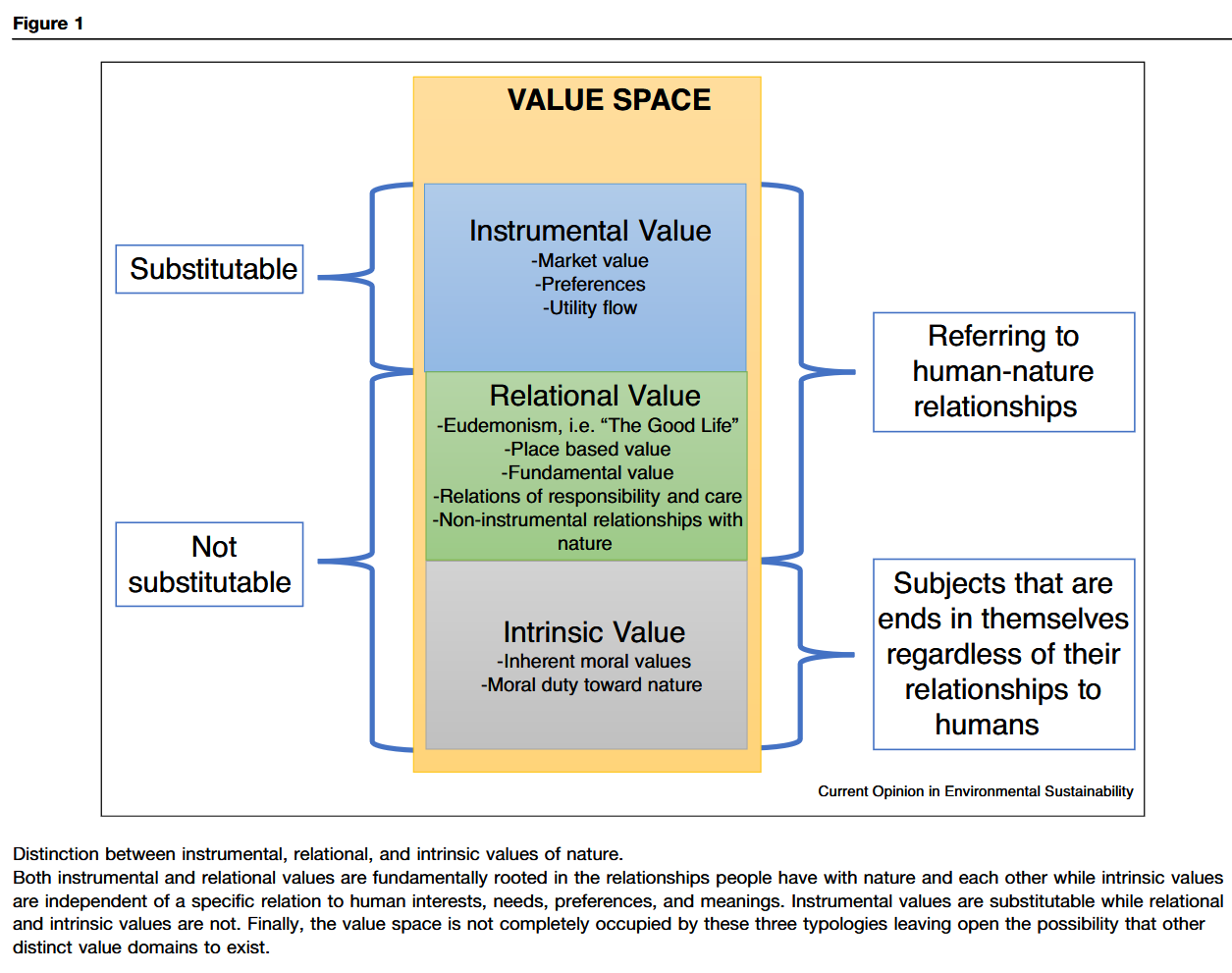
Himes & Muraca (2018) are extremely farsighted to leave open space for other distinct value domains to exist, and, here I would call these axiological dimensions, in line with Biedenbach & Jacobsson (2016). Axiology as one of the philosophies of science and a dimension of a research paradigm is far younger than ontology and epistemology which have until now been the two pillars for initiating metatheoretical discussions on research strategies (see Love 2002 in design theory or Alvesson & Sandberg 2011 for management studies). Reflexivity, relationality and pluralism are all signs of an incipient paradigm shift in knowledge production, not just evidenced by this paper or that article but by a larger shift occurring in humanity’s relationship to the planet and its web of life. What Himes & Muraca (2018) have built here is an axiological bridge between a plurality of knowledge systems (see Bhan & Tedjokusumo 2025) given that “relational values are essential to adequately represent non-Western languages of valuation” (Himes & Muraca 2018:3). As they explain, instrumental value tends to put a dollar figure on relationships:
The inclusion of relational values in pluralistic methods of valuation [offers] a framework for the articulation of human-nature relationships that challenges the Western dichotomic model of either conserving nature for its own sake (wilderness) or securing the utility flow of natural capital (instrumentality, eco-efficiency. (Himes & Muraca 2018:5)