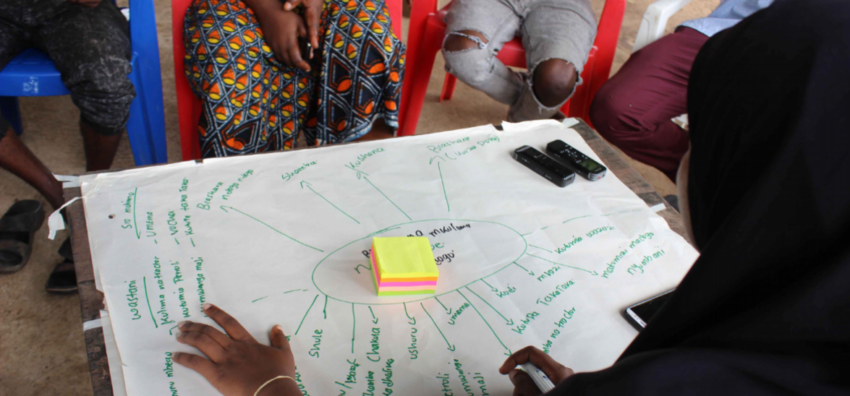
Ziervogel, G., Perumal, L., & Taylor, A. (2026). Applying design thinking for innovative climate adaptation solutions: Building capacity for locally led adaptation. Environmental Science & Policy, 184, 104481.
Almost from the start of my doctoral studies, I have appreciated the work of Dr Gina Ziervogel and her co-author teams. Ten years ago, for instance, Ziervogel et al. (2016) developed a three-pronged visualization of transformative capacity, in particular amongst low socioeconomic groups in urban South Africa. Today’s reflective review considers Ziervogel’s latest research, published last month (Ziervogel, Perumal, & Taylor 2026), which uses the popular understanding of ‘design thinking’ as a lens for convening and assessing multi-stakeholder collaborations for problem navigaton and solution development of ‘locally led adapation’ (LLA) to climate change. For the empirical component of their study, Ziervogel et al. (2026) collaborated with “the Hasso Plattner School of Design Thinking (d-school Afrika) and the Bertha Centre for Innovation & Entrepreneurship, all at University of Cape Town (UCT)” (p.2). I bring this to your notice because it identifies the flavour of design thinking referred to by Ziervogel et al. (2026), and is important for us to distinguish from the general usage of the two words together to refer to the way designers’ think (see Cross 2001). We will discuss its limitations later on against the backdrop of Ziervogel et al.’s (2026) own findings.
Four teams were convened after review and selection by Ziervogel et al. (2026) to participate in a 5 day design thinking sprint after a Phase 1 comprising a preparatory session and a systems thinking workshop. Phase 2 was the 5 day sprint based on the 5 stage process which comprises this popular version of design thinking as promoted by the d.schools. There was a Phase 3 for converting the concept-models into viable and feasible prototypes for real world implementation which finally did not occur. Thus Ziervogel et al. (2026) are only able to share their findings from implementing Phase 1 and 2. It is their findings which are of most interest to us as designers and planners of co-creation initiatives with multi-stakeholder groups in such multi-epistemological settings. I collapse their detailed and fascinating findings from the reflexive diaries of each team and their experience of the sprint into one key observation as captured by this longish extract from the discussion section (Ziervogel et al. 2026:6):
From the findings across the four teams, it is evident that challenge-led, facilitated design thinking does shift climate adaptation planning into a more targeted mode of tailoring prospective interventions to the nuances of individual situations and everyday lived-realities in local contexts. However, the process of getting teams through the stages of storming, norming and performing together to shift their thinking on the problem, formulate, test and potentially let go of preconceived notions of what can work, co-create alternative options, and refine them to a point that they can be validated by users and pitched to prospective investors, takes more time, support and iterative engagement than the design thinking sprint format allowed. While strong connections were made and various outcomes were sparked, on the whole teams were not yet adequately equipped to take the prototyped solutions forward outside of the programme. (Ziervogel et al. 2026:6, my emphasis added)
Sprints are fun but a closer look at the design of the 5 day sprint reveals a number of issues particularly in the sections highlighted by Ziervogel et al. (2026) viz., “Different teams experienced the stage 2.1–2.3 differently, as captured below:
- Team A experienced tension between what they were hoping for and understanding how the process might support that. Despite early frustrations, user engagement helped shift their perspective and result in a more user-driven POV.
- Team B focused heavily on framing their challenge from the outset but struggled to connect with users. Their POVs often implied solutions rather than articulating user needs, reflecting modest growth in user empathy.
- Team C, the largest team, pursued multiple aspects of the process simultaneously, which led to tensions around coordination but also curiosity and iterative learning. After a few iterations, their POVs were clearer but tended to be prescriptive, framing needs as solutions.
- Team D concentrated on the process, specifically defining the challenge, but engaged less with users. Although they gained clarity over time, their POVs lacked depth and were weakly connected to user needs”. (Ziervogel et al. 2026:4)
Stage 2.1-2.3 refers to user research, which in this 5 day sprint is not only allocated only 3 days (!!!) but its design planning is extremely ill-suited to the nature of the challenge for which it was implemented. I can already see how I would design the programme differently and introduce another workshop on Understanding Users & Context between days Stage 2.1 – 2.3 as well as re-ordering the stages themselves. I reproduce the entire 5 day stages 2.1 to 2.5 as a screenshot of Table 1 from page 3 of Ziervogel et al. (2026) here and then point out my concerns with this programme design.
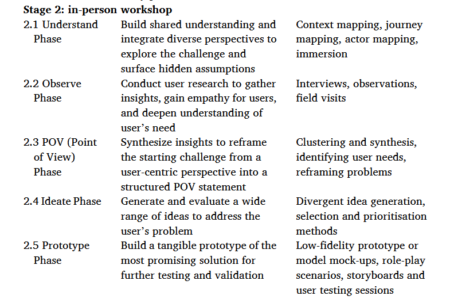
My issues and concerns are framed as questions I ask while you look at these days of work in the image above:
- Can we Understand before we Observe?
- Can we generate PoV statements before we identify whose PoV we will select?
- Can we Observe without knowing whom to observe?
Look at the right-most column where the activities of that sprint day are listed. Look at journey mapping and actor mapping and tell me how you plan to do that without identifying which users you will focus on, whom you select to interview (“user profiles”), where you will immerse yourself for field visits, and which context you will map. Would you not make Observations (day 2, stage 2.2) before you sprinted ahead to Understand? Wouldn’t that make more sense? Whose Point of View is a function of whom you select to Observe in order to Understand. Is it farmers for Team A and informal traders for Team B or municipality householders for Team C? When do you sit down and decide who are the most important people for whom you have convened here in this workshop to develop solutions for, whom you will interview to understand their point of view? I can go on forever pulling apart the work that must be done at the front-end (which has paid my bills for the past 20 years), so I’ll stop here.
I am horrified at this terrible design of the front-end work before stage 2.4 and 2.5. It was never properly developed by anyone who understood how user research – the aim of these three days – can be done in field settings such as in Africa, nor, does it look like this sprint was designed by anyone who had actually planned and implemented user research studies. Which is surprising given the high quality user research experts IDEO has employed over the years (see Fulton Suri for example). Many of the issues experienced by each team as highlighted in the bulletpoints quoted from Ziervogel et al. (2026) above can be correlated to inappropriate design of the design thinking sprint, including and especially the notion of a sprint as an appropriate tool for such work.
Who was responsible for the design methodological development of this 5 day sprint? I am terrified by the hot mess that such a rushed and ill-considered design for such an important co-creation initiative could even be promulgated much less implemented. No wonder none of the teams felt they were ready to move on to Phase 3 which would facilitate converting their ideas into practical actions. Ziervogel et al.’s (2026) bulletpoints above capture the user-centered issues (including Point of View) each team had to confront on their own within a short duration. Sprints are temporally inappropriate for the nature of the co-creation and co-design work involved for such societal challenges as climate change adaptation particularly in settings where local, traditional, and indigneous knowledge-holders must be involved ideally during co-creation but certainly during co-implementation.
Many of the issues raised by Ziervogel et al. (2026) in their results and discussion in this paper can directly be correlated to this badly designed sprint which is completely inappropriate for the design challenge it has been used to address. There was a systems thinking workshop in advance. Why wasn’t there a PoV or user research workshop included?
Overall, while the design thinking process enabled shifts in participation and problem framing, it did not fundamentally redistribute power or alter the structural conditions shaping adaptation decisions. Its primary contribution lay in surfacing tensions between experiential and formal knowledges, local priorities and institutional mandates, and exploratory collaboration and pre-defined organisational agendas. By addressing some dimensions of epistemic injustice and enabling more reflexive engagement, the process contributed to aspects of locally led and transformative adaptation. However, the short-term nature of the engagement meant these shifts were partial and contingent, underscoring that design-led approaches are starting points rather than solutions. (Ziervogel et al. 2026:7 with my emphasis added)
My argument is that design-led approaches are NOT starting points but the end-points AFTER time has been invested in understanding the Users and Context – the setting, the people, the climate change adaptation needs, and taking decisions on who, why, where, to plan and design an intervention. The most important part of the entire exercise is NOT a sprint nor a short term exercise. At best it is only an introduction to user-centric thinking. In fact, my argument would make a thesis, so we’ll just have to wait for mine to be published. On the other hand, I hope that this blogpost offers touchpoints for re-thinking co-creation for climate adaptation that is well-planned and well-designed based on front-end inquiry BEFORE convening a workshop of any duration. Without understanding such initiatives cannot succeed, this is clear in the way the sprint is designed but the approach to user understanding undermines and diminishes the power of this same understanding as derived from all the activities jumbled into 3 short days without a clear and coherent plan for sequencing techniques and tools or any attempt to adapt these stages to the African context. These issues, however, are not a limitation of Ziervogel et al. (2026) so much as they are limitations of design thinking as popularized and promoted by the d.schools without any serious methodolological development work for context and setting.