Niti Bhan

Lovingly made by human mind and hands

Menu
  • Home
  • About
  • Blog
  • Publications
  • Design Research
  • Contact
Menu

Category: Perspective

Why ‘Design Thinking Sprints’ Won’t Work for Climate Adaptation Solutions

Posted on November 26, 2026November 27, 2026 by Niti Bhan

Ziervogel, G., Perumal, L., & Taylor, A. (2026). Applying design thinking for innovative climate adaptation solutions: Building capacity for locally led adaptation. Environmental Science & Policy, 184, 104481.

Almost from the start of my doctoral studies, I have appreciated the work of Dr Gina Ziervogel and her co-author teams. Ten years ago, for instance, Ziervogel et al. (2016) developed a three-pronged visualization of transformative capacity, in particular amongst low socioeconomic groups in urban South Africa. Today’s reflective review considers Ziervogel’s latest research, published last month (Ziervogel, Perumal, & Taylor 2026), which uses the popular understanding of ‘design thinking’ as a lens for convening and assessing multi-stakeholder collaborations for problem navigaton and solution development of ‘locally led adapation’ (LLA) to climate change. For the empirical component of their study, Ziervogel et al. (2026) collaborated with “the Hasso Plattner School of Design Thinking (d-school Afrika) and the Bertha Centre for Innovation & Entrepreneurship, all at University of Cape Town (UCT)” (p.2). I bring this to your notice because it identifies the flavour of design thinking referred to by Ziervogel et al. (2026), and is important for us to distinguish from the general usage of the two words together to refer to the way designers’ think (see Cross 2001). We will discuss its limitations later on against the backdrop of Ziervogel et al.’s (2026) own findings.

Four teams were convened after review and selection by Ziervogel et al. (2026) to participate in a 5 day design thinking sprint after a Phase 1 comprising a preparatory session and a systems thinking workshop. Phase 2 was the 5 day sprint based on the 5 stage process which comprises this popular version of design thinking as promoted by the d.schools. There was a Phase 3 for converting the concept-models into viable and feasible prototypes for real world implementation which finally did not occur. Thus Ziervogel et al. (2026) are only able to share their findings from implementing Phase 1 and 2. It is their findings which are of most interest to us as designers and planners of co-creation initiatives with multi-stakeholder groups in such multi-epistemological settings. I collapse their detailed and fascinating findings from the reflexive diaries of each team and their experience of the sprint into one key observation as captured by this longish extract from the discussion section (Ziervogel et al. 2026:6):

From the findings across the four teams, it is evident that challenge-led, facilitated design thinking does shift climate adaptation planning into a more targeted mode of tailoring prospective interventions to the nuances of individual situations and everyday lived-realities in local contexts. However, the process of getting teams through the stages of storming, norming and performing together to shift their thinking on the problem, formulate, test and potentially let go of preconceived notions of what can work, co-create alternative options, and refine them to a point that they can be validated by users and pitched to prospective investors, takes more time, support and iterative engagement than the design thinking sprint format allowed. While strong connections were made and various outcomes were sparked, on the whole teams were not yet adequately equipped to take the prototyped solutions forward outside of the programme. (Ziervogel et al. 2026:6, my emphasis added)

Sprints are fun but a closer look at the design of the 5 day sprint reveals a number of issues Continue reading “Why ‘Design Thinking Sprints’ Won’t Work for Climate Adaptation Solutions”
The Joy of Problematizing Assumptions

Posted on November 17, 2026November 17, 2026 by Niti Bhan

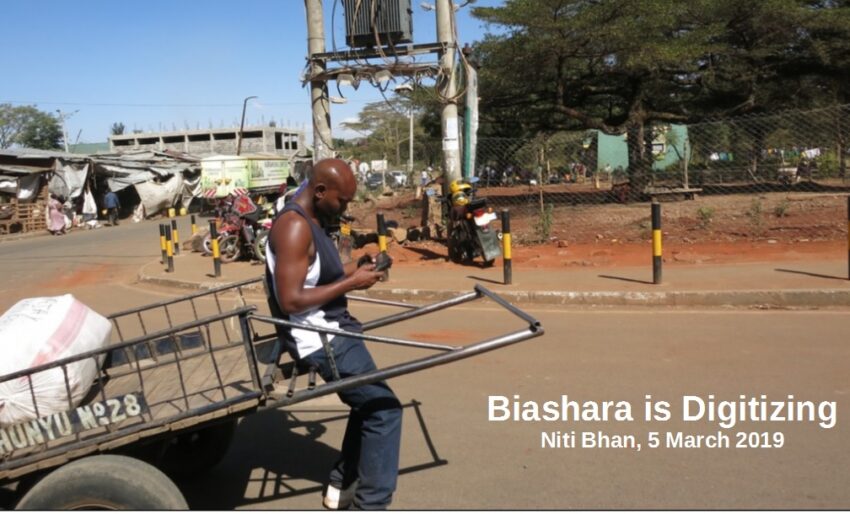
The man in this photograph I took in Nairobi some years ago is clearly a manual labourer, one who earns his daily bread by hauling his handcart powered only by the strength of his muscles and the fuel in his belly. More often than not, he won’t be able to refuel if he does not haul today.

However, there’s something very interesting going on. You have to peer closely to see the smartphone in his hands, a digital disruption that is the latest leg of the mobile telephony revolution which transformed the majority world’s informal economies. I was in a moving car. I can’t help myself. I’ve been doing this for years.

Of course I put him on the cover of a talk I was invited to give to the innovation unit of Kenya’s leading telecommunications provider (a telco). Look! I said, biashara is digitalizing and y’all have contributed massively to transforming the informal sector in many many ways. Let me show you how. I rapidly sketched the diagram below for an early look at what was happening. Biashara being the colloquial swahili for trade and commerce. Continue reading “The Joy of Problematizing Assumptions”

Success stories in prepaid dominant markets

Posted on November 16, 2026November 16, 2026 by Niti Bhan

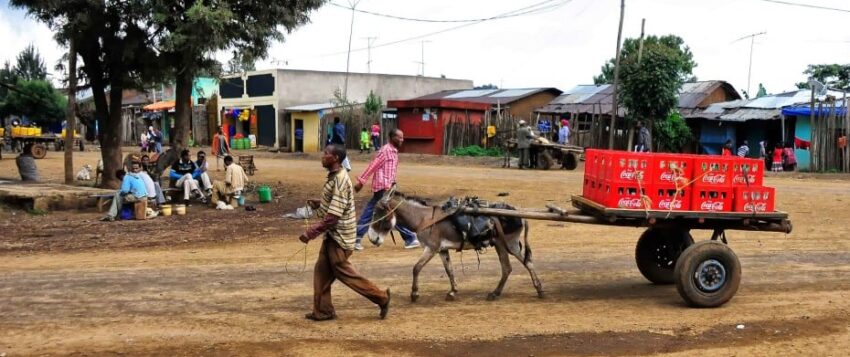
In my world, innovation success stories are far and few between. Prepaid dominant markets correlate to prevalence of economic informality, and the informal sector/informal economy is well recognized as the high growth sector offering jobs and employment in the majority of what is inaccurately called the Global South. Formal sectors of the economy, also called modern sector, tend to be significantly smaller proportionally, unable to accommodate the majority of the working age population in these locales. These two sectors are rarely demarcated by a clear line of control so much as the region where they overlap is a borderland of grey areas – a continuum of varying degrees of formal and informal structures and arrangements. Even a mega-multinational such as Coca Cola will end up with informal retailers comprising their absolute last mile of reach in the most remote hinterlands.

At some point in the value web of relationships which comprise informal trade ecosystems (Bhan & Gajera 2018; Bhan & Rytilahti 2026) a hand-over occurs between a formally recognized distributor or micro-wholesaler and the wooden kiosk that may serve as the local tea stall or coffee shop with a cooler box full of cold drinks. What is important here to recognize is that regardless of the formal registration status of the kiosk owner, they are able to offer you a soda baridi (colloquial swahili for a cold drink) which is very likely to be a Coke. This blurring of boundaries between formality and informality, between the registered and the unrecorded, this continuum is a fact of life in the supply chains of consumer markets in the Majority World. 

This makes the point that it is impossible to succeed in such consumer markets without a recognizing and confronting this reality, that of the informal economy and its ability to make or break the success of a product, a service, or a business model which aims for greater reach and penetration than simply the top 5 or 10% of the population by socio-economic demographic data. It is this reality which results in the biggest brands you can think of running away making excuse or blaming the local markets for their failure. And, it is this reality which the mobile phone designed and manufactured by Nokia together with the prepaid business model pioneered by farsighted telcos that transformed the world’s most invisible target audience. That is why I called these opportunity spaces “prepaid dominant markets“.

In this metaphorical world, assumptions break down as a matter of course rather than as an outlier. Continue reading “Success stories in prepaid dominant markets”

Do we take the notion of co-creation for granted?

Posted on November 14, 2026November 13, 2026 by Niti Bhan

Long ago, I wrote about the magic of eureka and how it was transitorily resident within moments of collective creativity (the expanded form of the word co-creation as used in the discourse of design research). Innovation, it seemed, was not the product of a solitary genius locked inside a garrett to starve or produce. Instead, it was built – bit by bit – in conversations, whether formal and facilitated in a group setting such as a workshop or informal and happenstance in a corridor or coffee room. An idea would be thrown out and then shaped and tweaked and sliced and reframed and described and manipulated by the collective voices of everyone who picked it up and rolled it around for a taste in their mind’s eye for a moment or more. Discarding some bits or adding an element, it rolls around and around until it takes its shape that makes everyone go ‘aha’ – the regular word for eureka, the shout of an ‘aha’ attributed to Archimedes in his bathtub at it overflowed displaced by his volume. Long ago, I left my own ‘aha’ at this point after blogging the merest wisp of an idea.

Some 20 years later, I sit here, once again, late at night (at least in the continent where I’m currently located) pondering whether we take this simple act of co-creation far too much for granted and emphasize instead co-design, (or co-development, co-innovation, co-et al. as the case maybe), that is, the outcomes of this mobilization of collective creativity (the “product” of co-creation) rather than the act itself (the “process”). Almost as long ago, Sanders & Stappers (2008) distinguished co-design from co-creation by saying “co-design is a specific instance of co-creation” referring to “collective creativity as it is applied across the whole span of a design process” (p.6). Perhaps, that is why we, as designers who would prefer to collaborate on creative works with others on our team rather than scribble alone in some remote corner, take it so much for granted since “collective creativity” is always preferentially “applied across the whole span” (Sanders & Stappers 2008) of our assumed model of a design process.

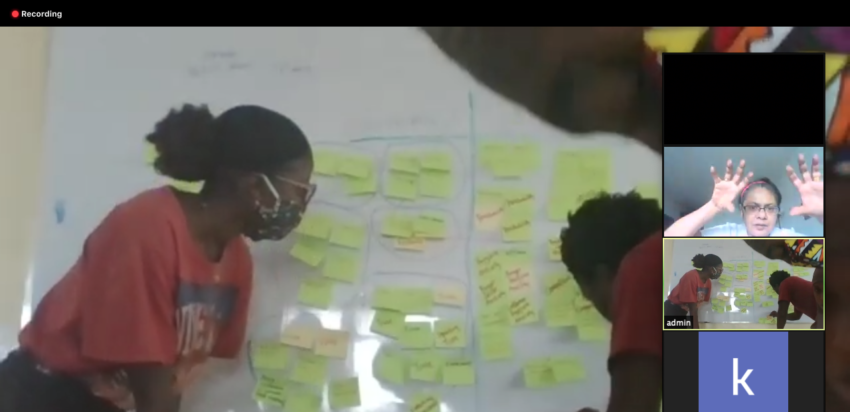
The featured image in this post is a Zoom session’s screen captured back in September 2020. I am facilitating a thematic analysis session for novices in collaborative design practices such as this sensemaking workshop conducted at the end of a co-creation project designed and implemented with vegetable vendors in the absolute last mile of Nairobi’s fresh produce supply chain; they kept the lowest income neighbourhoods supplied with nutritious perishables like leafy green veg (without refrigeration) by shouldering the risks generated by travel and curfew restrictions imposed due to the Covid 19 pandemic. Only when distance, disease, and digital screens separated me so profoundly from the rest of my team did I pause and then stop taking the “magic” of the collective “eureka moment” (co-creation generates its own creative energies and some of us have learnt to thrive on it) for granted. I don’t think I can ever take the chemistry which generates creative energy when a group or team is humming with ideas and throwing them out to stick against the way for granted again.

Continue reading “Do we take the notion of co-creation for granted?”

Dancing in between knowledge and its making

Posted on November 11, 2026 by Niti Bhan

There is a super-imposition of worldviews that may feel disconcerting, and certainly, unsettling, when one returns to school much later in life for a terminal degree. Reading fulltime professional academics talk about the way their assumptions and viewpoints are disturbed made me realize I don’t experience the same because I haven’t spent the past 30 years being conditioned by the formal academic structures of ‘how to think’ and ‘how to make knowledge’ they way they have. There’s nothing long-settled to be destabilized. I’m a novice. I haven’t been conditioned to think in a certain way nor the outputs of my creative spark carefully ‘disciplined’ for peer review.

This has its pros and cons. On one hand, it has taken me far more time to arrive at the framing of my thesis since I had to learn the established before I could confront it. On the other hand, I do not have to grapple with the discomfort generated by going ‘against the grain’. I’m ‘dancing in between’ the legacy infrastructures of knowledge-making and the blindspots it generates (see Konadu-Osei et al. 2023). For those of us who can discern the multi-coloured landscape of knowledge rendered invisible by the hegemonic knowledge production systems, there is a freedom in not having to overcome conditioning in order to reach out and collaborate.

Building Bridges From Prototype to Production

Posted on October 23, 2026October 24, 2026 by Niti Bhan

Reading “Bauhaus and Mass Production” on the Bauhausian digital platform makes me want to add some of my thoughts on the gap the author identifies as seminal to understanding the legacy of the Bauhaus.

The Bauhaus was a laboratory for industrial design, but laboratories generate failed experiments as well as successful transfers. Its most useful story is not that it solved mass production. It learned to design for the possibility of reproduction—and then encountered the economic realities that determined whether reproduction actually happened. (Bauhausian.com, n.d.)

The Bauhaus aimed to build bridges between the materials of industrial production and the craft of design as they experimented with new ways to manipulate new materials (steel tubes, for example). The bridge being built here was industrial design purposefully aimed at the needs of mass production, as the author points out above. That is, a bridge between design and engineering. What was missing here was business (“economic realities”), the third leg of innovation. That would arrive as its own set of design constraints many decades later.

The German Bauhaus … represents an important and significant endeavor toward devising both a general definition of design and a method of design education in the twentieth century. Although … the Bauhaus was closed in 1933, it was to be reborn in 1937 in Chicago under the name of the New Bauhaus. (Findeli 1990:4)

As Findeli (1990) describes, circumstances led to Moholy-Nagy (the German Bauhaus teacher who founded the Chicago school) being requested to “reorient its pedagogical program to bring it more in line with the priorities of Chicago’s skeptical businessmen” (p. 6). That is, the foundation of the design + engineering orientation to prepare industrial designers for mass manufacture which the German Bauhaus is recognized to have established (Bauhausian.com, n.d) came to America where it was encouraged to confront commercialization in earnest (Findeli 1990). In effect, the original blend of design + engineering was now being asked to shake hands with business.

This means that the statement, “form follows function,” has to be supplemented; that is, form also follows – or at least it should follow – existing scientific, technical and artistic developments, including sociology and economy.“‘ (Findeli 1990:10 citing Moholy-Nagy, emphasis added)

Findeli (1990) does not pursue that little snippet I emphasize in the quote above any further in his paper, which instead focuses on design pedagogy and its philosophical foundation as developed by Moholy-Nagy. It is here that I will have to jump forward in time another number of decades to arrive at the point where we have come to take for granted that a blend of design, engineering, and business is the expected knowledge-base of professionals working at the very front-end of product development.

Continue reading “Building Bridges From Prototype to Production”

Does a chatbot dream of research paradigms?

Posted on October 22, 2026November 13, 2026 by Niti Bhan

Weber, J., & Prietl, B. (2022). AI in the age of technoscience: On the rise of data-driven AI and its epistem-ontological foundations. In The Routledge Social Science Handbook of AI (pp. 58-73). Routledge. 

As I engaged with the meta-theoretical foundations of knowledge-making for scaffolding methodological development in my doctoral thesis, I increasingly began wondering what were the underlying set of assumptions (called inquiry paradigm by Lincoln & Guba 1995, 2005; also research paradigm, Pretorius 2024) which informs knowledge products spat out of a machine in response to a prompt. The dimensions of these ‘sets of assumptions’ are recognized as epistemology (the nature of knowledge), ontology (the nature of reality), axiology (the nature of values) in addition to methodology which together encapsulate a ‘research paradigm’; it lays the foundation for any systematic program of knowledge-making. Here, in the age of generative AI, when pop-ups in academic publishers’ websites offer to ‘make sense’ of the article you clicked on, it raises the question: what are the assumptions on knowledge and reality and values which underlie the knowledge product constructed by a machine? What is it’s research paradigm? How might I navigate any incommensurabilities between it’s assumptions and mine? Or, is the legacy dominance of positivism being imposed on us, regardless of our own paradigmatic preferences (e.g. constructivism or pragmatism) simply as a result of using past data to predict future content?

The book chapter I link to here by Jutta Weber and Bianca Prietl offers me some answers to these questions; and, in a way, confirms my worst case scenario. Continue reading “Does a chatbot dream of research paradigms?”

There is a new lens by which I can see

Posted on October 16, 2026October 17, 2026 by Niti Bhan

I was taken by surprise today as I reviewed a couple of links I’d bookmarked to return to after my manuscript revision was complete. In the first, blogged on The Prepaid Economy blog, I suddenly found myself noticing that the work done over the past 20 years on the informal economy was, in fact, a means to ‘dismantle the monolith’. Here, the monolith is clearly that of an undifferentiated and unsegmented mass of peoples lumped together under easy-to-use labels such as “informal sector” or “bottom of the pyramid” which collapse all diversity, heterogeneity, and plurality into the convenience of one single lens by which to call them all. Four (4) billion peoples live on “$2 a day” and lost all other distinction not to mention individuality when they became “the BoP”. The informal economy does not even get this discretionary cash flow as a distinguishing factor. All of it around the world is relegated to the shadows, outside the lines clearly drawn for “formality”. It struck me then, as I pointed out how this most recent research (by the OECD) is the first I’ve seen which explicitly states what we’ve been saying for 20 years: One size does not fit all. In order to dismantle this monolithic view predicated on grand challenge scales (“the next billion” as the target “user” for planning design actions), one must unpack the patterns of financial behaviour at the level of first principles in order to construct models to segment that which cannot be predicted.

I’ll come back to this later, here I want to move on to the second link I reviewed this morning, one on community environmental behaviour observed during a South African research study in a rural community. Empirical data contradicts dominant narratives which assume financial incentives will be required for the poor to involve themselves with sustainability. Interestingly however, what they found was community actions on climate change adaptations were motivated by ‘ubuntu’, the Southern African philosophy predicated on kinship and relationality.

A long-standing idea in environmental research is that people are more likely to care about the environment, and do something to prevent environmental damage, once they earn enough to stop worrying about paying their bills. But what happens in rural communities with high levels of poverty, where money is scarce and environmental changes directly affect people’s livelihoods? We are economists who wanted to find out what explained environmental action best: income levels, or the strength of people’s connections to their fellow community members (Kirsten & Biyase 2026)

A relational viewpoint is revealed by the link between actions taken and the ‘strength of people’s connections” (Kirsten & Biyase 2026). The stronger the relationality, the more likely the community would take actions which would benefit all and future generations. The ‘long-standing idea’ which Kirsten & Biyase (2026) overturn with empirical evidence is an assumption in their line of work which can be problematized, as they have done. It is the result of taking a ‘rational’ viewpoint which rooted in positivism and the scientific method. Recognizing this, too, I now realize, is part of ‘dismantling the monolith’ since relational viewpoints, such as those illuminated by Kirsten & Biyase (2026) are closely identified with indigenous research paradigms, underpinning the relational axiology of indigenous knowledge systems (Chilisa 2019). There is much more to be said here but I will stake a step back instead to consider both the links and my response to them.

I can see clearly a nuanced shift in my interpretation and understanding. It is also clear that it results from the work done over these past 6 or 7 months on constructing a (meta) theoretical and conceptual frame for my doctoral research. Here now, I will pause reflexive analysis and pick it up again once I have materials to share in public. Suffice to say, I did not expect this. And must ponder its implications.

Photo taken by Niti Bhan, Eastern Cape, South Africa, January 2008

Playgrounds of the mind

Posted on October 15, 2026October 17, 2026 by Niti Bhan

They say, in the department, that nobody ever reads the synopsis (also called exegesis or kappa) except the examiners. So I followed the standard template assiduously. And failed spectacularly. Oh, I had original contributions to make, my examiners were convinced, but my presentation of my dissertation research was not only not accepted for publication (and hence public defence) but the decision agreed by all was that this was a major revision. Not a minor one. Not a moderate one. Not an outright rejection either. Nope. It was ‘go back and do it all over again’.

So I did.

As I sit here now, less than a week after sending it in again for re-examination, I can only think that this decision was the best thing that ever happened to me in my doctoral journey. A major revision comes with ample time to think, to review, to revise, and to rewrite. The committee offers you 12 months for delivery. I aimed for 3, then aspired to finish in 6 but by the time the myriad little details were all worked out and last minute corrections shoved in, it was almost 7 months before it was ready to go public. I hope my examiners haven’t forgotten me, I’ve been in my cave for so long.

This time I wrote something that wanted to be read. Its a nuanced difference, but I think an important one for me.

I now approached it as the public dissemination of academic scholarship as a doctoral candidate of a university whose birth I remember. Whose reveal party I attended in September 2007; whose prototype I toured in September 2008; and whose research community I joined in September 2019. Yet, interestingly, no matter how often I look back over almost 20 years of involvement, I cannot find any evidence that I could have ever produced anything of this quality and positionality had I begun writing my doctoral thesis any earlier than this time of life.

That is, this is not the dissertation of what is commonly known as “an early career researcher” although technically, according to the formal academic definition, that is exactly what I am at this grand old age of 60. I remember telling someone I’m not “early career” anything at this point. On one hand, as my publications show, I have only a handful of peer reviewed scientific research articles; a popular way to assess the relative “earliness” of a researcher’s career. On the other hand, I have more than 10 commissioned research reports and a track record of funded research projects going back the same 20 years. Its complicated, she said.

For now I will use the status of ‘Independent Researcher’. Its a good enough at this moment in time. I have built reputations, brands, and careers over the past 36 years. Now, I will undergo my own major revision; in no small thanks to the fatal crash of this website.

It opens a new question: What do I want to build next?

This is an absolutely wonderful question. It motivates. It does not inspire. But, what it does is, leave open many possibilities and many searchways for inspiration. In the meantime, I have my blog up and running. And, that, perhaps, is the most important thing of all at transitional times like this.

Here be ‘playgrounds of the mind‘ (with apologies to Larry Niven)…

lovingly made by human mind and hands

Posted on October 15, 2026October 17, 2026 by Niti Bhan

What do I mean by “lovingly made by human mind and hands”?

This is a short note on the tagline in the header of this website. It was written in response to the preponderance of technologies used to generate and disseminate “content” once I realized that not only was I building this site by hand, as much as possible using the barest minimum of tools available for the back-end but that I would write each and every word by hand and mind.

Out there on the internet, blog and bulletin board conversations ponder the question whether its still worth keeping a blog in the age of gen AI. Interestingly, one of the most popular answers is that a blog offers a track record of thinking and writing. Only when I saw ‘How To’ guides on writing without the help of technology did I realize the trend now to recapture the early spirit of blogging from 25 years ago. And to re-establish the human voice and p2p communication.

I would rather put errors and typos out there than run my thoughts through a machine for perfecting. It is the same rule I followed for my entire doctoral thesis. And, it is the way I learnt to write more than 50 years ago. I don’t see why I need to give that up now.

So, this is a crude handmade object. Let’s see how it fares in today’s ‘online’ and then perhaps look back and compare with how things were 20+ years ago when this domain was established and the first blogpost launched.

  • 1
  • 2
  • Next

Africa assumptions axiology blindspot climate climate adaptation climate product development climate services climate services design co-creation collective creativity design design methodology design research design research methodology design sprint fails facilitation fuzzy front-end horizontal portability human-nature relationship informal economy innovation knowledge systems majority world markets meta-research mobile phones mobile telephony nature-centric design new product development one size fits all ontology pluralism prepaid economy project planning reflexive review relational values smartphones user-driven climate adaptation products user-driven climate products user inquiry user needs user research user values UX research vertical subsumption

  • Axiology
  • Co-Creation
  • Design
  • Long Read
  • Marginalia
  • Perspective
  • Playground of the mind
  • Reflexive Reviews
  • Research
  • Strategy
  • November 2026
  • October 2026

Business Registration

Emerging Futures Lab

Y-Tunnus 2607854-3

Ymmärrys ry

Y-Tunnus 3288926-2

.

Design Research Services

Lorem Ipsum

©2026 Niti Bhan