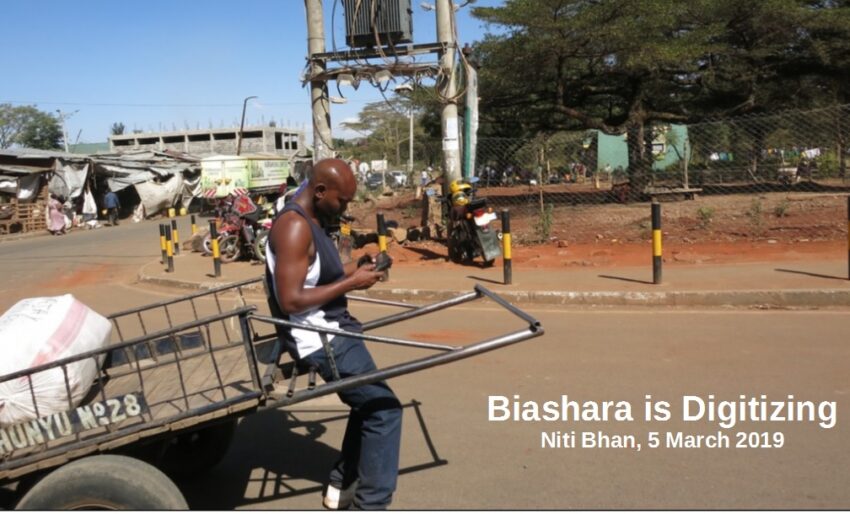
The man in this photograph I took in Nairobi some years ago is clearly a manual labourer, one who earns his daily bread by hauling his handcart powered only by the strength of his muscles and the fuel in his belly. More often than not, he won’t be able to refuel if he does not haul today.
However, there’s something very interesting going on. You have to peer closely to see the smartphone in his hands, a digital disruption that is the latest leg of the mobile telephony revolution which transformed the majority world’s informal economies. I was in a moving car. I can’t help myself. I’ve been doing this for years.
Of course I put him on the cover of a talk I was invited to give to the innovation unit of Kenya’s leading telecommunications provider (a telco). Look! I said, biashara is digitalizing and y’all have contributed massively to transforming the informal sector in many many ways. Let me show you how. I rapidly sketched the diagram below for an early look at what was happening. Biashara being the colloquial swahili for trade and commerce.
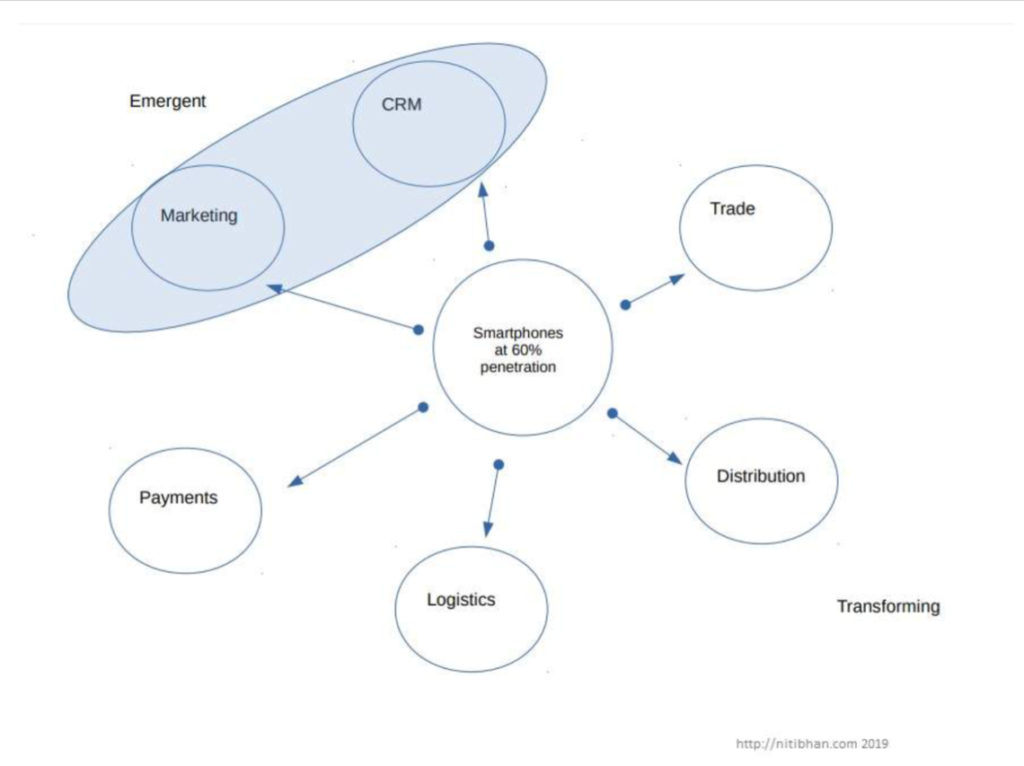
Kenya’s smartphone penetration has increased by double digits since I first made this diagram for that talk to illustrate how entirely new sectors of activity were emerging as a result of this powerful tool in literally ‘everyman’s’ pocket. The handcart owner taking a break by the side of the road ‘under the hot sun’ (jua kali in swahili, the informal sector’s formal name in Kenya) is now liberated from having to wait for customers to find him if he hands out his number to each of them. He need not fear theft if he carries the day’s earnings in his pocket because MPesa, the Kenyan mobile money transfer pioneer, lets him accept digital payments (as well as store it, make payments, or link directly to a bank account). He might even be running two other lines of business using a chat message app or some social media platform. We don’t know, we can’t tell. However, the point is, that we cannot assume either.
Dominant narratives of “low productivity” and “unskilled” manual labour never had to confront the smartphone and its impact (or even a featurephone, which in the majority world can do everything I described above). And, dominant narratives which tend to be damage-focused and deficit-laden could never dream of a manual labourer who pulls a loaded handcart across the city using muscle power alone would take a break to check in on his apps much less afford one. This is not the popular media representation of a “poor African man eking out a life on the streets” etc. (Wait till you see the Indians, even the taxiwallah knows there’s something called AI while he uses a QR code to buy his lunch).
That’s why I put this photograph on the cover. Its layered with any number of assumptions on who, what, where, why, and how; none of which can be taken for granted or left unexamined. That way lies failure.