Chaudhry, N. A., Collins, W. D., Anthoff, D., & Jones, A. D. (2026). Building user-driven climate adaptation products. Nature, 654(8118), 337-342.
After my concerns in yesterday’s post on methodological gaps in popular versions of “design thinking sprints” for climate adaptation solutions, it is with great relief that I present research (PDF) published this year in Nature journal. What is most intriguing is that Chaudhry, Collins, Anthoff, and Jones are all climate scientists: two affiliated with UC Berkeley and two from Lawrence Berkeley National Laboratory. On one hand, this explains their fluency in the uncommon article structure preferred by Nature. On the other hand, it raised both my eyebrows on the quality of their introduction to ‘a demand-driven model’ for ‘climate product development’, written without a single co-author from any of the design disciplines.
Earlier this year, Gruendel & Mareis (2026a) had introduced a special issue in a top design journal on “frameworks that explain design’s contemporary ubiquity across diverse fields” (p. 2). They also wrote a conclusion (Gruendel & Mareis 2026b) on “some cautious directions what a project of design studies beyond the remit of the traditional design fields might become in practice” (p. 98). I had cited them earlier this year but even I never imagined I would confront energy and meteorological scientists fluently singing the language of my own discourse.
Chaudhry et al. (2026) publish what I would have loved to write using a title which I would have been glad to use in a journal like Nature. On the other hand, it is the experienced scientists who can and will open doors to product development and design in their own discourse where we can only follow, given the relative youthfulness of design as research discipline (Cash, Daalhuizen, & Cross 2025). What is further interesting is that Gruendel & Mareis (2026b) assumed design’s diffusion across disciplinary boundaries would remain confined to the humanities and social sciences, whereas Chaudry et al. (2026) clearly disabuse this assumption. Given the venue of their introductory foray, we can only expect to see more scientists learning to talk in design language.
As I read their work, it makes me wonder whether such a publication has already made obsolete much of what Gruendel & Mareis aimed to frame re: the ‘design turn’ (2026a) and its future (2026b). From Chaudry et al. (2026) it is clear that the value of design – for their work in climate product development – has less to do with its ability to give shape to the future and more to do with its orientation towards building solutions that resonate with the intended target audience i.e. user-centric climate products. Prosaic, and perhaps taken for granted by design scholars, but as Chaudry et al. (2026) argue, its a crucial and important contribution to the climate sciences which no other discipline can offer. To put it concisely:
…information that supports adaptation to climate risks is increasingly urgent. This need has accelerated demand for climate services, products, and tools (“climate products”) that support climate-informed decisions. Despite the growth of climate products, many have fallen short of initial expectations. This partly reflects a one-directional, supply-driven model in which “developers” (often scientists and researchers) prioritize supplying better data and assume that more information will drive improved decision-making and action. Supply-driven climate products are scientifically driven but typically misaligned with user needs and decision requirements, limiting uptake and use (Chaudhry et al. 2026:337 with emphasis added)
Frankly, climate scientists have woken up to the fact that their wonderful science is useless if it cannot build bridges across the usability gap (Chaudhry et al. 2026). Recent reviews of mine reveal the various user related issues found by teams of scientists studying the uptake of climate services products and climate adaptation solution development approaches. In the crossdisciplinary discourse of the climate sciences, becoming user-centered is now mission critical and this is now clearly recognized as evidenced by the very existence of a Chaudhry et al. (2026). However, design (as a practice, as a discipline, and as a discourse) has much catching up to do (Cash et al. 2025) if they are to now take a seat at the scientists’ table (having asked for and recieved that seat in the boardrooms and the C-Suites). An entertaining gallop through a 5 day sprint won’t cut it, particularly if its sequence of activities at the front-end for user research are ill-designed and unsuitable for purpose and goals. In contrast, it is clear Chaudhry et al. (2026) have done their homework well.
Below you will note that “Identify Users” (Table 1, Chaudhry et al. 2026) and “Understand Context” which also includes identify the users (Table 2, Chaudhry et al. 2026) stands in clear contrast to the issues I discussed in yesterday’s post on the ‘design thinking sprint’ 5 day workshop which overlooked COMPLETELY the need to identify users before you can either understand them or observe them, in this inaccurate sequence of activity.
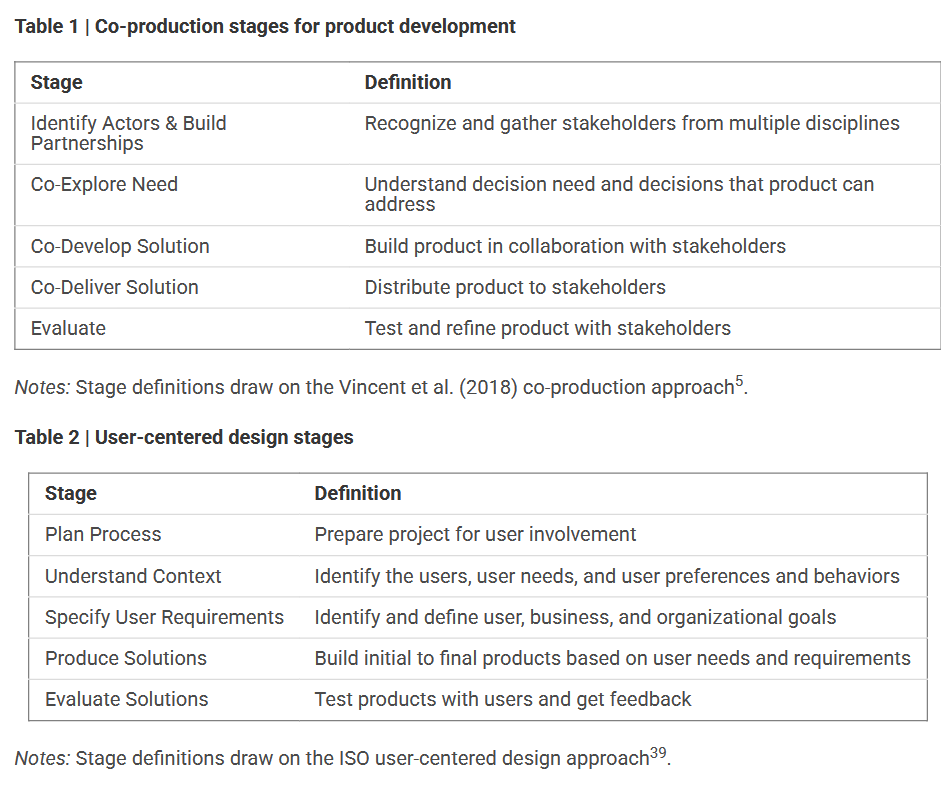
Chaudhry et al. (2026) also foreground the most pressing need in climate product development which is what they refer to as “co-production” to align with collaborative knowledge production in the sciences, but we would recognize as “co-creation”. Since they cite Sanders & Stappers (2008) we can rest assured my assumptions are infact empirically supported by their arguments. Here, I do not proceed further with their observations on the need to blend insights from transdisciplinary co-production and user-centric design approaches for flexible yet contextualizable solution development planning of such projects because my doctoral thesis awaits publication. Once done, I shall return and update this post. In the meantime, I can happily close this blogpost with a sigh of relief that the best journal with the top scientists from leading research centers have recognized and articulated an argument which I have struggled with since November 2023. I have no regrets in seeing their most excellent research article published in Nature. At least somebody said this out loud to the people who need to hear it the most for the future wellbeing of our shared planetary home.