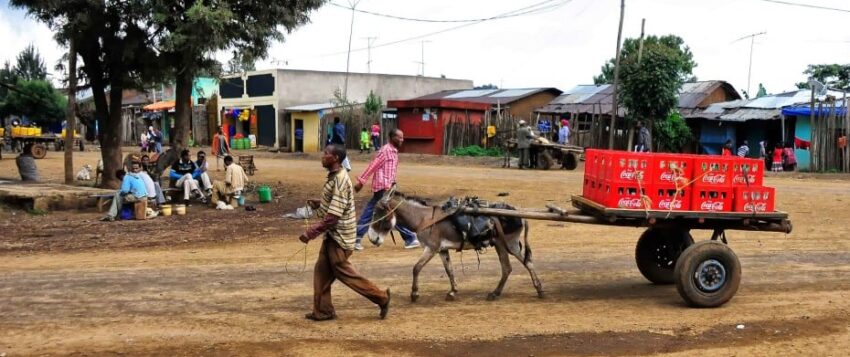
In my world, innovation success stories are far and few between. Prepaid dominant markets correlate to prevalence of economic informality, and the informal sector/informal economy is well recognized as the high growth sector offering jobs and employment in the majority of what is inaccurately called the Global South. Formal sectors of the economy, also called modern sector, tend to be significantly smaller proportionally, unable to accommodate the majority of the working age population in these locales. These two sectors are rarely demarcated by a clear line of control so much as the region where they overlap is a borderland of grey areas – a continuum of varying degrees of formal and informal structures and arrangements. Even a mega-multinational such as Coca Cola will end up with informal retailers comprising their absolute last mile of reach in the most remote hinterlands.
At some point in the value web of relationships which comprise informal trade ecosystems (Bhan & Gajera 2018; Bhan & Rytilahti 2026) a hand-over occurs between a formally recognized distributor or micro-wholesaler and the wooden kiosk that may serve as the local tea stall or coffee shop with a cooler box full of cold drinks. What is important here to recognize is that regardless of the formal registration status of the kiosk owner, they are able to offer you a soda baridi (colloquial swahili for a cold drink) which is very likely to be a Coke. This blurring of boundaries between formality and informality, between the registered and the unrecorded, this continuum is a fact of life in the supply chains of consumer markets in the Majority World.
This makes the point that it is impossible to succeed in such consumer markets without a recognizing and confronting this reality, that of the informal economy and its ability to make or break the success of a product, a service, or a business model which aims for greater reach and penetration than simply the top 5 or 10% of the population by socio-economic demographic data. It is this reality which results in the biggest brands you can think of running away making excuse or blaming the local markets for their failure. And, it is this reality which the mobile phone designed and manufactured by Nokia together with the prepaid business model pioneered by farsighted telcos that transformed the world’s most invisible target audience. That is why I called these opportunity spaces “prepaid dominant markets“.
In this metaphorical world, assumptions break down as a matter of course rather than as an outlier. Strategy and planning for market entry has no choice but to be inquiry-led. The ample consumer-centered data easily accessible in established markets does not exist. Or may only apply to an extremely small percentage of the potential customer base. This is not frugal or bottom of the pyramid or any such lumpen categories used in the past two decades to describe such mass market opportunities. This is the reality of distribution, demand, and design. That is, between your ambitions and your customers lies an unmapped terra incognita. The success stories, whether its a durable good like a mobile phone or an FMCG product like a cold drink, are those who made the effort (or experienced a miracle) to discover and understand the market as whole. Each becomes a case study in understanding how these markets work and why these products/services/business models were successful.
Here, success in the consumer market is not about pivoting to become a non-profit or social enterprise surviving on donor funding and selling to NGOs (a very popular strategy for a range of products designed for such target audiences). Nobody ever handed Nokias out for free but nobody can deny they sold like hot cakes in markets where nobody, not even the company, imagined they would. Understanding why and then retroductively assessing if some general principles to refresh the long taken-for-granted assumptions in the way we think about, plan, and implement strategy is a timely and crucial knowledge base that needs both meta-research as well as methodological development. I might take the time to ponder this opportunity space as concisely described in this blogpost.