A typology to synthesize ways of conceptualizing the values of nature across diverse disciplines and knowledge systems may be organized on the basis of the following four interrelated dimensions:
- worldviews and knowledge systems (ontologies and ways individuals or groups interpret, inhabit, and modify the world around them)
- broad values (life goals and guiding principles),
- specific values (opinions and judgments about the importance and meaning of something in specific contexts), and
- value indicators (the quantitative measures or qualitative descriptions of importance given to specific values). (Himes et al. 2024:26)
Within the wider values typology, specific values reflect how people, communities, and societies justify why and how nature and people–nature relationships are important to them (Himes et al. 2024:26). As part of their axiological studies, Himes et al. (2024) “identify the most frequently recurring meanings in the heterogeneous use of different value types and their association with worldviews” (p. 26).
This caught my attention. In the discourse of design research, my co-author and I argued that *users’ values, when left untouched, would generate frictions in policy and practice (Bhan & Rytilahti 2026). I want to talk about the limitations we discerned in user research methodologies in practice, as opposed to theory or policy. That is, while many policy frameworks or documents stated that human-centric design approaches aimed to uncover and understand user needs and values, the subsequent descriptions of practices and/or approaches ended up focusing on user needs alone. User values tended to get left by the wayside (Bhan & Rytilahti 2026) as evidenced by our secondary research on gaps in implementation (p. 10-11). On p. 9, we cite a participant from a study on foresters in Finland and their nature-based values whose words illuminate the situation as it stands right now:
People are more heterogeneous. Forest owners are completely different today, and have a variety of interests compared to the old days when all of them came from the countryside… there’s a totally different starting point [nowadays]. (Study participant quoted in Häyrinen et al. 2017:16)
That is, even in an allegedly homogenous society such as Finland’s, we cannot simply assume that everyone’s worldviews and values are more or less the same, and thus, do not require any especial study. As Himes et al. (2024) suggest, it is “pluricentric worldviews” which “focus on a web of reciprocal and systemic relationships between human and other-than-human beings” after considering both “biocentric and ecocentric worldviews”, despite their differentiation in environmental ethics, “because they share a nonanthropocentric perspective and can both be considered nature centered” (p. 29). In our qualitative evidence analysis and synthesis (Grant & Booth 2009), we focused only on “nature centered” livelihoods in rural Finland such as forestry, farming, and fishing. If we do not have design research methodologies that can discern user values alongside user needs, then we risk what Hirsch Hadorn et al. (2008) have called ‘severe harms’ to society. This gap was identified by our diagnostic work at the front-end of such complex and open design problem spaces (Bhan & Rytilahti 2026).
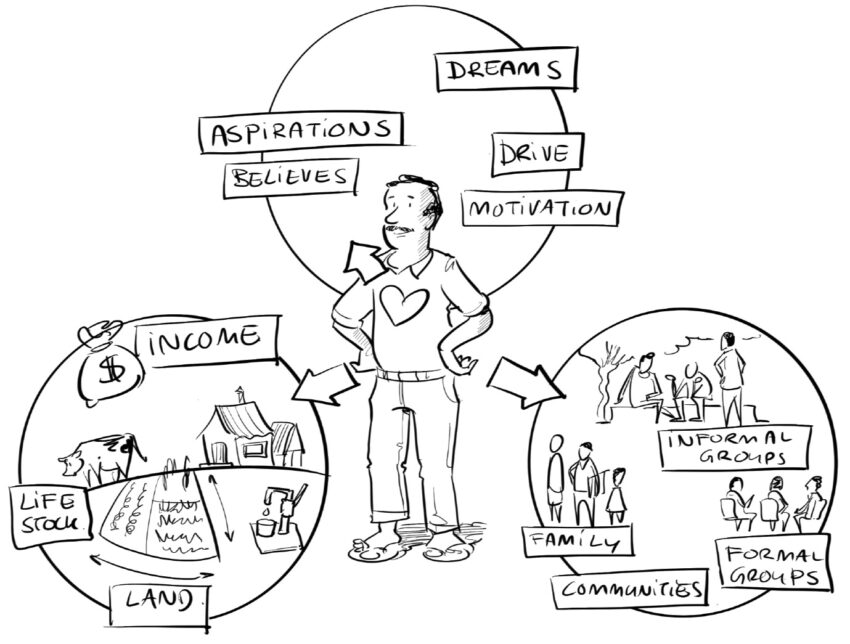
More than a decade ago, the illustration which is the featured image for this blogpost was made by Jeroen Meijer of Jam Visueldenken of Amsterdam to represent visually my argumentations (as the designer/researcher on the team) to the Dutch government that a comprehensive update to understanding the “users” of their sustainable agricultural value chain development efforts would be timely and necessary if they were indeed to implement farmer-centric public-private partnerships (PPPs). Now, when I take a big step back to look at it holistically I can see that what I had proposed was an axiological study. Axiology, according to Biedenbach & Jacobsson (2016), refers in the philosophy of science to “the role of values and their influences on the knowledge creation process” (p. 140). Axiology is also commonly understood as the study of values, given that we cannot understand their role or influence without inquiring into them. This is what Himes et al. (2024) do for nature centered values as cited in this blogpost, further extending their axiological studies in Himes et al. (2025). Himes & Muraca (2018) distinguish relational values as incommensurable and distinct in and of themselves, contributing to the classical typology of values embraced unquestioningly by Biedenbach & Jacobsson (2016).
The argument I wish to make here is that we do not yet have a door to open for axiological studies in human-centric design research, thus laying the foundation for meta-research and design methodological development for user inquiries and contextual research. A robust meta-theoretical foundation is necessary (Love 2002) to scaffold robust and horizontally portable methodological work (Bhan & Rytilahti forthcoming). The current orientation towards user needs in practice is a friction-generating limitation of empirically established design research methodologies; and thus, a legitimate motivation for scientific engagement (Sato 2000, 2009). This is not a case of a practice-theory gap so much as a gap in theory which in turn generates missing opportunities for practice (see Poggenpohl & Sato 2009).