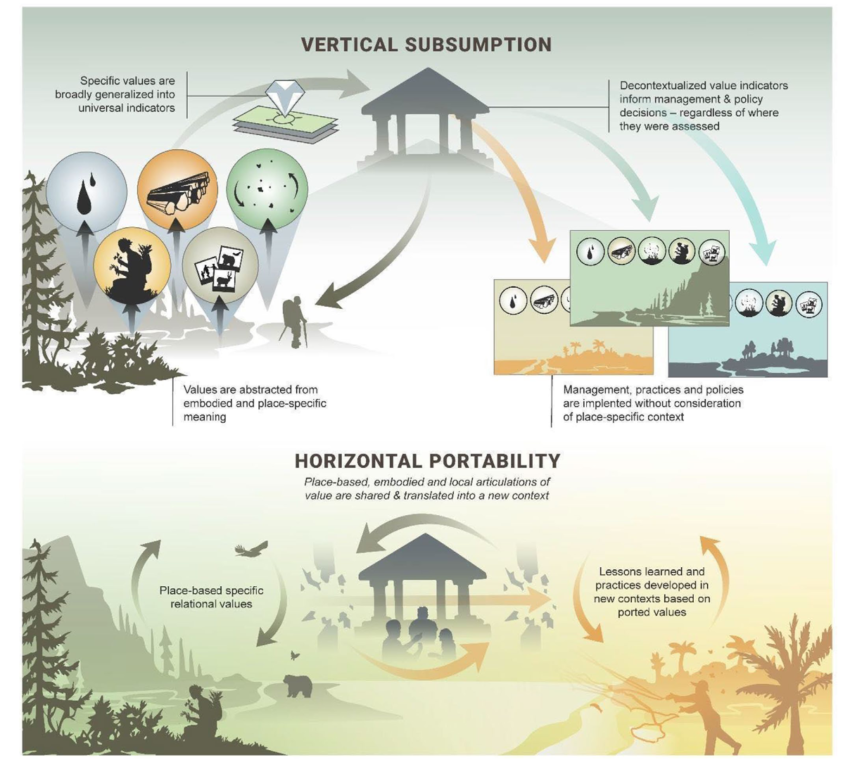
Himes, A. et al. (2025). Horizontal portability: a proposal for representing place‐based relational values in research and policy. People and Nature, 7(4), 752-764.
Humankind’s relationship with nature and the web of life – their relational values – are particular to a place and a setting. Himes et al. (2025) argue that simply extracting generalities from such axiological studies and then applying them elsewhere does not work. They call this vertical subsumption, as seen in the featured image above. Instead, they suggest ‘horizontal portability’ (Himes et al. 2025) for just, equitable, and plural axiologies. The implications of recognizing and applying the notion of value pluralism (Himes et al. 2024:36) are significant for planning and implementing co-creation projects with multiple knowledge systems (Bhan, forthcoming).
When Whanganui Iwi (Māori) people declare of the Tupua River, ‘I am the River and the River is me’ (Tupua Whanganui River Claims Settlement Act, 2017) it is clear that the relational value of the river cannot be replaced by anything else and that the cultural and ecological components of a place and the people that belong to it are not easily separable. (Himes et al. 2025:753)
According to Himes et al. (2025), relational values are incommensurable with compensation or substitution, such as the loss of a trusted friend. You may make other friends who may also be as closely beloved but they can never replace the friend who was lost. Thus the same applies to humankind’s relationships with nature, being deeply rooted to a place, community, and sense of belonging, contributing to one’s own identity. “Relational values are more often associated—in comparison to other value types—with a ‘context-specific perspective’, which suggests that they lose meaning when separated from their specific biocultural context” say Himes et al. (2025), who “refer to them in terms of place-based relational values” often contituting “the collective identity of local communities” (p. 753). For human-centric design research undertaken for project information development (sometimes called user research, see Bhan & Tedjokusumo 2025), understanding users’ values is crucial for co-creation of efficacious public services (see Bhan & Rytilahti 2026).
Elucidating place-based relational values is essential to accurately representing the valuers’ direct experiences and understanding, as well as their unique relationships with, and knowledge of specific places. (Himes et al. 2025:753)
However, dominant approaches to research and policymaking results in what they call “vertical subsumption”, a top-down viewpoint which aims to extract “generalizable” insights. “In the process, however, such values become disconnected from the specific relationships and places that constitute their meaning” (Himes et al. 2025:754). This analytical strategy, while considered helpful in translating “place-based values into abstract categories that can be more easily classified, measured or compared” is nonetheless the result of the invisible yet taken-for-granted assumptions of Eurocentric knowledge production systems and their research paradigms (Himes et al. 2025:754). In decolonial thought, such a dislocation of content from context has been called zero-point hubris by Santiago Castro-Gomez (English translation, 2021).
What often legitimises the process of vertical subsumption is the understanding that specific practices, knowledge systems, and associated values are the particular expressions of general categories and that they can be adequately represented by a delocalised, abstract, and universal language. (Himes et al. 2025:754)
Thus, vertical subsumption strips values “of their place-based meaning and made suitable to be communicated regardless of their specific context” (Himes et al. 2025:755), a reflection of science’s rootedness in the set of assumptions encapsulated as positivism and/or postpositivism (Chilisa 2019:46-48). By proposing the alternative approach of horizontal portability, Himes et al. (2025) problematize one of the fundamental most-taken-for-granted assumptions in knowledge-making (see Alvesson & Sandberg 2011). Horizontal portability is inspired by Indigenous research paradigms. Kovach (2009), cited by Himes et al. (2025), describes Indgienous theory for methodological development as not being “universal, [but] portable to other sites”. Here, Himes et al. (2025) are careful to footnote their interpretation of portable as “an alternative to universal” but not necessarily embedded in criteria for Indigenous methodologies (Kovach 2009). That is, it is the portability of a notion or concept which has caught their attention; although it is clear that if one is working with Indigenous knowledge-holders and their axiologies (values) then the relevant criteria should apply (see Bhan & Tedjokusumo 2025 linked to above).
‘Horizontal’ indicates an effort to allow the specific expression of relational values rooted in a particular biocultural context to speak to different people outside of that context on ideally equal terms (Manuel-Navarrete et al., 2021; Tschirhart et al., 2016). Equal terms does not only mean that asymmetry of power should be minimised, but also that specific expressions are not subsumed into larger, over-arching categories that do not correspond to how communities rticulate what matters to them in their own terms. (Himes et al. 2025:756)
An example of this viewpoint is clearly visible in our field study on Indigenous ways of knowing for disaster preparedness with communities residing on the slopes of a live volcano (Bhan & Tedjokusumo 2025) – as we explain after our discussion, we had to commission three rounds of translations before we could unearth the voices of the people in their own words rather than formal English. This is why we prefer the word ‘equitable’ rather than ‘equal terms’ as used by Himes et al. (2025), since we do not then need to qualify its usage as they have to do as quoted above. The main point here is that horizontal portability offers an approach to learn from and use insights from what is ‘essentially unique’ and ‘situated knowledge’ and thus simply writing this blogpost will not be enough. Horizontal portability will have to be unpacked and applied for design research at the front-end, especially for nature-based livelihoods and the values and knnowledges of those livelihood communities. This reflexive review may only begin opening the door to further design methodological development work, inspired by Himes et al. (2025) as below.
Horizontal portability is not new to many Indigenous traditions nor to practices of encounters among non-Indigenous local communities; it has been a modality of reciprocal communication and exchange for centuries through storytelling, cultural celebrations, ceremonies, collaboration, gift exchange, cross-fertilisation of practices, reciprocal learning and commoning among people from different social-ecological contexts. What we propose is to take these practices as a model for an alternative design in research and policy around the valuation of *nature that can interact with and complement vertical subsumption. (Himes et al. 2025:756)