Harrison, J., & Whyte, J. (2026). Future-Making in the Front-End of Projects. International Journal of Project Management, 102854. https://doi.org/10.1016/j.ijproman.2026.102854
Interestingly, Harrison & Whyte’s (2026) conclusions inspired me to conceptualize and set up a class of blogposts which I am calling ‘Reflexive Reviews’ (see categories in the right-hand sidebar). What naturally caught my eye was their advocacy for “for more inquiry-led planning in projects” (p. 5), given the arguments I make in my article-based doctoral thesis and my 20 years of front-end inquiry for informing client projects as well as my own research studies. A reflexive review, thus, becomes a way for me to intersperse my observations from field studies and from client project management experiences with the contents of their essay. Whether the reflexivity of my dialectical engagement with literature on my blog is ‘critical reflexivity’ or not is path dependent on the research selected for such a review. I believe it was Alvesson & Sandberg (2011) who observed that the “critical” in ‘critical reflexivity’ can sometimes overwhelm the “reflexivity” (see pg. 252).
Here, I take the stance of an experienced practitioner in doing more or less that which Harrison & Whyte (2026) advocate for in their discourse of project management. What is interesting is that what I’ve been doing has its roots in the front-end of human-centered design and product development, also called innovation planning or design planning (Owen 1992, 2001; Kumar 2012; Keeley et al. 2013). I will use another quote to help explain where I discern nuanced differences between understandings of inquiry, planning, and the front-end when approached from different disciplines (see Davies, Manning & Söderlund 2018). Emphasis is added to distinguish the two viewpoint they compare.
We suggest that project planning could benefit from complementing early-stage certainty and commitment with more reflexive and inquiry- led practices that allow for iteration, divergence, and adaptation over time. (Harrison & Whyte 2026:5 with emphasis added)
Harrison & Whyte’s (2026) analysis and explanations were so relevant that I wondered for a moment if they were reading Owen too and interpreting his arguments for weaving together their strands of discourse. Instead, what I noticed is that they are almost there, at his arguments for an additional phase of work at the very front-end of an innovation and/or product development project. Here’s their comparative table of analysis (a screencap is all I could muster at this time but it should suffice for discussion) from page 3 of Harrison & Whyte (2026):
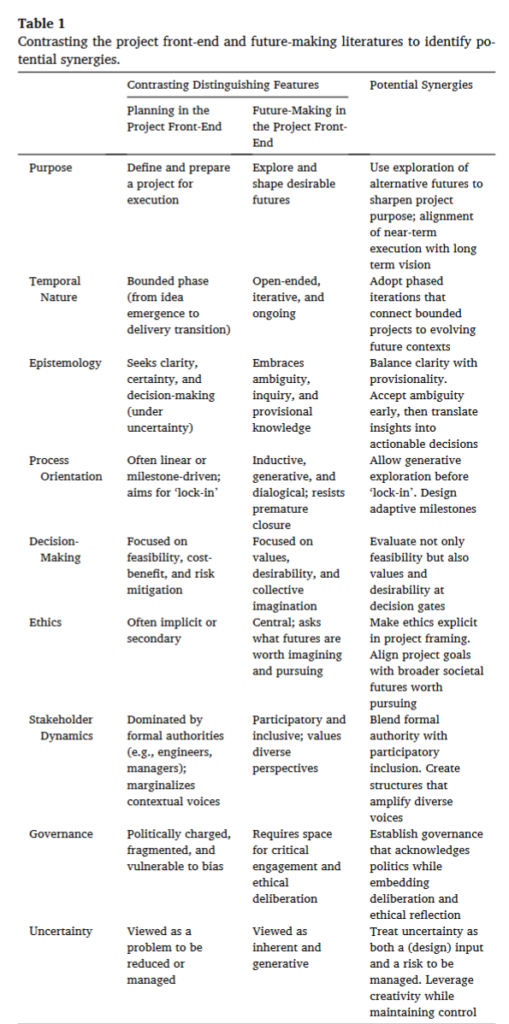
What I see here is the ripeness for a sequential multi-paradigm inquiry (Lewis & Grimes 1999) in this front-end of project planning. One which combines the distinguishing features of both approaches being contrasted in the table by Harrison & Whyte (2026). That is, there is room and need for both viewpoints, and, thus, for temporal sequencing. Sharon Poggenpohl describes this better in her second individually written chapter (Poggenpohl & Sato 2003), when discussing the two ‘dominant design paradigms’ as identified by Dorst (1997). Suggesting that rather than consider them as incommensurable, consider them as complementary, Poggenpohl (2003) builds on Dorst’s analysis (1997), both of whom trace these dominant viewpoints in design research to, respectively, Herbert Simon’s seminal work the Sciences of the Artificial for the rational ‘design paradigm’ (I prefer to use viewpoint, distinguishing from inquiry paradigms, Lincoln & Guba 1995, 2005); and, Donald Schon’s work for the reflective ‘design paradigm. These two viewpoints – the rational and the reflective – may also be discerned in the comparative analysis above by Harrison & Whyte (2026). At a more concrete level of abstraction, what they’re doing here is a multi-paradigm research technique called paradigm bracketing (see Lewis & Grimes 1999). Assumptions which underpin each of the two strands of discourse (project front-end and future-making literatures) are embedded in the contrasting distinguishing features as pinpointed and articulated by Harrison & Whyte (2026). There are indeed potential synergies; it is this which made me recollect the work of faculty such as Owen and Poggenpohl at the Institute of Design, Illinois Institute of Technology (ID-IIT) on this front-end structure and planning blended with ethnography, design, and thus, the necessary room for maneuvre embedded in design discourse notions of concept as a working hypothesis (Bhan & Rytilahti 2026).
Reading through Harrison & Whyte (2026) carefully makes me wonder whether the issues raised by the authors are those which result from an underlying meta-assumption (Alvesson & Sandberg 2011, 2013) which permeates all scientific endeavour, regardless of discipline, that of ‘certainty’ as an idealized goal. Thus, even those fields and strands of study which resist and critique such a viewpoint, may not be wholly able to shake off the overall conditioning of scholarship within the academy; far more subtle but well recognized as, among other things, ‘the scientific method’. “Future-making at the front-end” can also be argued, based on one commonly recognized understanding of design, as “the front-end of design/innovation”; after all, you may also recognize the close and intertwined relationship between design itself (particularly as a practice) and the making of a possible future (see Peschl & Fundneider 2016 for an example). After all, the acts and thoughts of design are intentionally purposeful and goal-oriented towards manifesting tangible visions of possibilities of that which does not yet exist. More so when you associate the idea of innovation with design. This perhaps is why Davies et al. (2018) were found in this paper, given their arguments on the asymptotic lines of discourse between innovation studies and project management. I would argue from my own position that since design has begun permeating all other disciplines (Gruendel & Mareis 2026); its time design stepped up to recognize itself and describe alongside its own distinguishing features. Any design/innovation planner who works in the terra incognita before we arrive at a concept (however tentative it may be) to begin giving form to the rest of the project (planning actions, mobilizing resources, project design and development, etc) will recognize this “potential synergy” from the last row of Harrison & Whyte’s (2026) table for the criteria of “Uncertainty” which I reproduce below:
Treat uncertainty as a both a (design) input and a risk to be managed. Leverage creativity while maintaining control (Harrison & Whyte 2026, Table 1, page 3)
Uncertainty is the only certainty, I once said, as the opening lines for a talk on a consumer insights study we’d once undertaken for mobile phone design in frontier markets very long ago. The informal economies of the world, where I chose to practice design ethnography and other mixed methods inquiry for almost 20 years, is not only rife with uncertainty, but it informs business model design, business development strategies, preferred payment plans, and a host of other factors. Uncertainty as the dominant paradigm of the operating environment within which one must plan is the groundbreaking design research I undertook in 2009 as foundation for my professional practice. So I will not open that discussion and explanation here, instead I note that there is scope for some qualitative research papers sitting right here at this confluence of unexpected lines of thought. Instead, what I would like to add to this reflexive review is a diagram made by Charles Owen (2001) to illustrate why the front-end must comprise two steps.
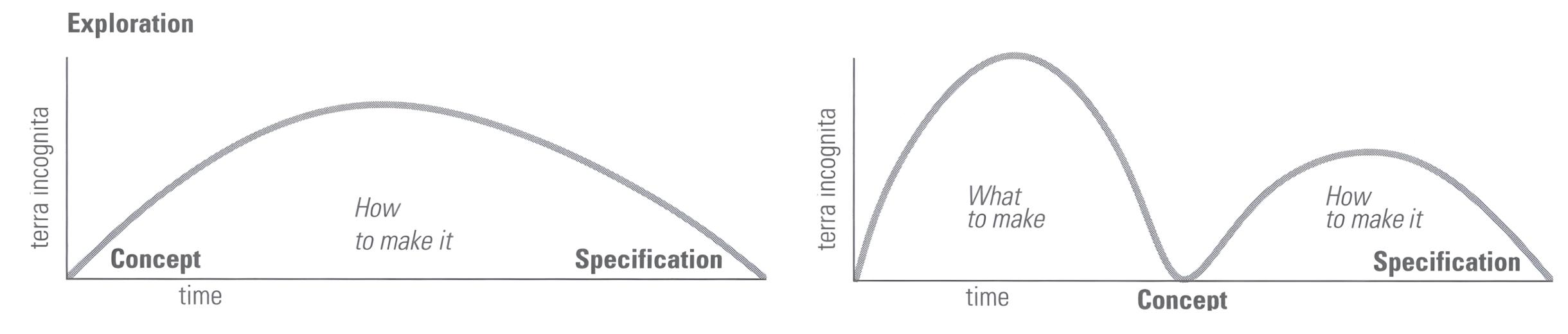
What is interesting and thus excites me is that it is these two comparative strands situated side by side in the table above by Harrison & Whyte (2026) which allow for a clear recognition that Owen (2001, 1992) was asking for the “future-making” column to be added as a step before the “project planning” column at the very front-end of product development. He began asking for this two step approach in the early 1990s and called it structured design planning. It has undergone nomenclature changes but its essential argument is not dissimilar to Harrison & Whyte’s (2026): we need exploration and discovery at the very beginning as inquiry to inform our planning of our project. This argument is in Bhan & Rytilahti (2026) (download PDF) published in The Design Journal. In turn, this requires bespoke inquiry design, as argued for by Bhan & Tedjokusumo (2025) in the International Journal of Design
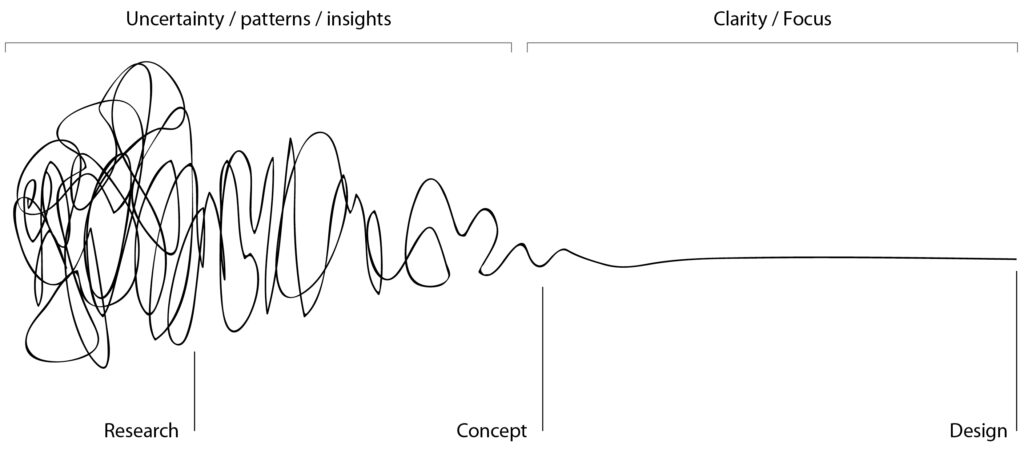
What is missing from Harrison & Whyte (2026) is the notion of a concept, as commonly understood and used in practice and scholarship of design. The concept, in this research setting (the two strands of discourse compared in the table above), would act as a bridge between the two viewpoints as reflected in their contrasting distinguishing features (Harrison & Whyte 2026). Damien’s squiggle above illustrates the punctuation offered by a concept between the period of uncertainty and the period of clarity. It also makes it obvious that the ‘project planning’ discourse, as described by Harrison & Whyte (2026) begins thinking from the moment of the concept while the ‘future-making’ discourse begins with the non-linear exploration and discovery-driven inquiry (“research”) phase. Uncertainty describes terra incognita, marked by Owen (2001) above in his diagram. Terra incognita is where I operate as an independent design researcher, both for project information development (Sato 2009) and academic scholarship (Sato 2000). I will stop even what I am calling a long read here for now since there is as much to be said about how one negotiates for such ambiguity in large scale and complex problem spaces with the funding client organizations. On the other hand, I must conclude it is exhilarating to find published literatures such as Harrison & Whyte (2026).