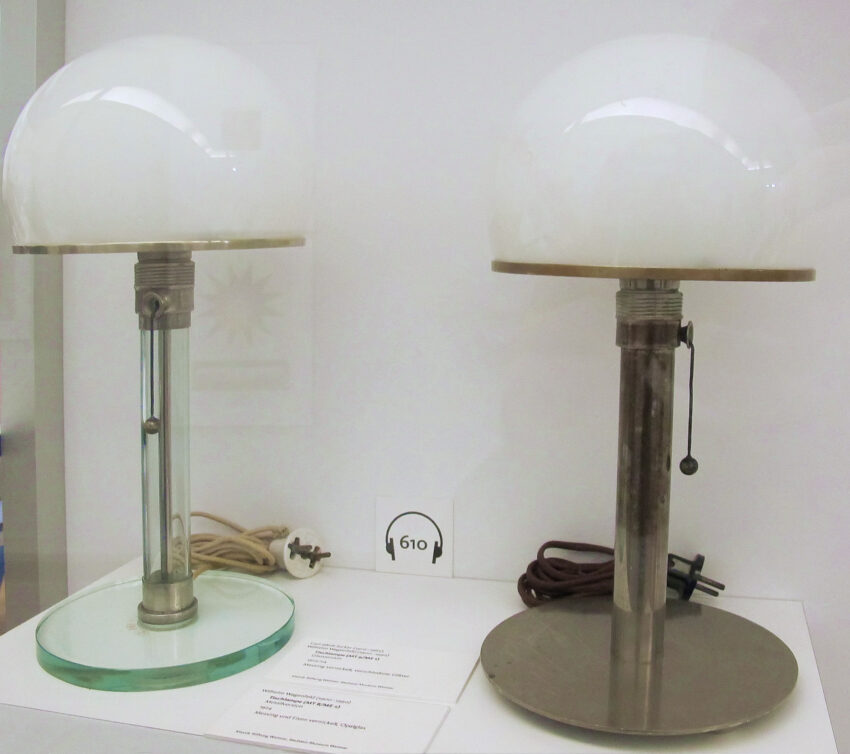
Reading “Bauhaus and Mass Production” on the Bauhausian digital platform makes me want to add some of my thoughts on the gap the author identifies as seminal to understanding the legacy of the Bauhaus.
The Bauhaus was a laboratory for industrial design, but laboratories generate failed experiments as well as successful transfers. Its most useful story is not that it solved mass production. It learned to design for the possibility of reproduction—and then encountered the economic realities that determined whether reproduction actually happened. (Bauhausian.com, n.d.)
The Bauhaus aimed to build bridges between the materials of industrial production and the craft of design as they experimented with new ways to manipulate new materials (steel tubes, for example). The bridge being built here was industrial design purposefully aimed at the needs of mass production, as the author points out above. That is, a bridge between design and engineering. What was missing here was business (“economic realities”), the third leg of innovation. That would arrive as its own set of design constraints many decades later.
The German Bauhaus … represents an important and significant endeavor toward devising both a general definition of design and a method of design education in the twentieth century. Although … the Bauhaus was closed in 1933, it was to be reborn in 1937 in Chicago under the name of the New Bauhaus. (Findeli 1990:4)
As Findeli (1990) describes, circumstances led to Moholy-Nagy (the German Bauhaus teacher who founded the Chicago school) being requested to “reorient its pedagogical program to bring it more in line with the priorities of Chicago’s skeptical businessmen” (p. 6). That is, the foundation of the design + engineering orientation to prepare industrial designers for mass manufacture which the German Bauhaus is recognized to have established (Bauhausian.com, n.d) came to America where it was encouraged to confront commercialization in earnest (Findeli 1990). In effect, the original blend of design + engineering was now being asked to shake hands with business.
This means that the statement, “form follows function,” has to be supplemented; that is, form also follows – or at least it should follow – existing scientific, technical and artistic developments, including sociology and economy.“‘ (Findeli 1990:10 citing Moholy-Nagy, emphasis added)
Findeli (1990) does not pursue that little snippet I emphasize in the quote above any further in his paper, which instead focuses on design pedagogy and its philosophical foundation as developed by Moholy-Nagy. It is here that I will have to jump forward in time another number of decades to arrive at the point where we have come to take for granted that a blend of design, engineering, and business is the expected knowledge-base of professionals working at the very front-end of product development.
One can stand look back over the past 100 years or so since the vision of industrial society’s design needs were articulated in the Bauhaus philosophy. The ‘economic realities’ of manufacturing have also themselves changed dramatically (see Owen 1991 for a concise era analysis); today, advancements such as 3D printing and ‘smart’ factories (among other things) feed their own insights back into the practice and profession of industrial product design and development. Just as they did with tubular steel so long ago. A prototype now may also never enter into mass production, as Bauhausian says above, but its economics have transformed entirely. It is now viable and feasible to build just one single product (Owen 1991) if desirable, as affordably as those made at scale. In fact, contemporary constraints on mass manufacture would raise the question whether scale itself is economically feasible anymore, sustainably speaking, even if its still viable and desirable when one ignores all contextual costs but that of the profit maximizing bottomline. It is here, in answering such questions, that the prototype continues to play its role as a bridge between concept (Owen 1993) and reality, and, one could say, extrapolating from Findeli (1990) between theory and practice, as well as art and technology (p. 6-7).