
Liberating myself from technical specifications of word count, third person voice, tone and choice of words is the power given to me in my own blog space – my ba, if you will – where I can play around with bits of ‘knowledge’ and rearrange them as I will. There are new concepts that I must understand and the only way I understand new concepts is to ponder them out loud, ideally with the capacity to come back and read and reread. I have used this blog for this purpose since 2005.
“…an opportunity to explore the double standard that exists concerning the acceptance of Traditional Knowledge by practitioners of Western science.” (Nicholas, 2018)
Today, I want to map the conceptual landscape of knowledge systems so that I can see them in my mind’s eye. This may be a clumsy thread of snippets and comments and observations and extracts but it will serve its purpose. I write for myself.
“…yet this difference cannot simply be reduced to a question of culture. It is at an intersection between knowledge systems where the role of power becomes apparent.” (Castleden et al., 2017)
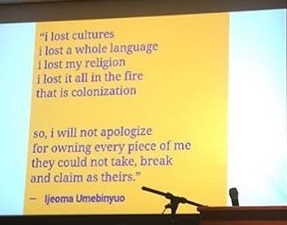
As I read, I wonder if I am simply the flotsam and jetsam emerging from the clash of knowledge systems and the ‘fire that is colonization’? My situation, my generation, the era in history in which I completed primary and secondary schooling, the school system, its function, nature and purpose, and its location, all come together with a violence that I only come to recognize today as that which has left me with little on which to stand upon except that which I myself can build, as a foundation, now, in my 50s, as a novice scholar. I cannot even write a single error free sentence in my mother’s tongue and its ancient script. Then, I discover the purpose of this blog. It is to remind me of the work I have already done, and free me to move forward to the next steps.
“In many ways the principles behind, and the processes of, colonization advance, develop, and promote research philosophies and practices that continue to transform the (re)production of knowledge; knowledge that controls and dismisses indigenous or “other” knowledges, beliefs, and practices as inferior. (Western) scientific method has historically been presented as neutral, objective, and representative of the Truth. Research grounded in these methods has functionally served to vivisect the world, cutting across interconnections, lives, cultural knowledge, and bodies, often with good intentions and occasionally espousing a critical approach even as it reproduces the status quo. Such dissections leave the objects of research scarred, producing and reproducing knowledge that defines the borders of exclusion and projects denigrated caricatures of the other to be internalized as grotesque truths about one’s own being and community.” (Brayboy et al., 2012 pg. 428-429)
Some of us can simply study and do what must be done. Others, I am discovering, cannot avoid, no matter how hard they try, the learning journey that has been called transformative (Mezirow) or the practices described as reflective (Schon). These are the new word forms I have developed my skills in using over the past two years and I cannot avoid them either, even though I am simply pondering out loud on this blog, as I have ever done. My voice has changed, and will probably change again. The music of the keyboard is different but it flows without impedance, and is not blocked as it was through the years in which I allowed the professional persona to constrain me.
“I felt dissatisfied with the prevailing discourse of representationism, with the computational model of mind, and with the dominant epistemology. Why? I am not really sure myself. … One reason may have been that I came from another country with a different culture and, therefore, never really belonged; in addition, I had not been educated in the standard U.S. way. It helped, I suppose, that I really came to the United States from another planet.” (Francesco Varela in Gumbrecht, Maturana, & Poerksen, 2006, pp. 43–4)
Resident alien is the official terminology for a green card holder in America, my piece of plastic sits in some archival folder gathering dust. Here, we simply struggle with my extreme Otherness in complicated intersectional ways, not the least is which the fact that permanent residents are not yet a large enough demographic to be designed for in the student services system. So, after 15 years, I receive emails written for newcomers as ‘international students’.
“The assumption, then, is that the same standards are valid for everyone, and that it is the students’ differences (cultural or other) that cause unsatisfactory performance.” (Engels-Schwarzpaul, 2013)
Which in turn reflects back to me the knowledge which I felt was missing from my own jigsaw puzzle of being and doing – that I possess or represent more than just the ‘Western’ knowledge system within which I was educated, in a colonial outpost churning out proper elite outputs of the British tradition of the public school. For this, I must credit every single person I have ever met and conversed with in the rural and urban informal economic system as prevalent in the continents of Africa and Asia. Diving into their worlds and understanding their challenges, constraints, and conditions – even as I began to recognize the vast disparity between the way the informal economy was represented in policy and scholarship and the lived reality of the peoples I had met – has contributed to expanding my own worldview and appreciation of local and traditional knowledges in a way that my own schooling never did.
“What they share, however, is their viewpoint (which often translates into a distinct view of the world) from outside the mainstream and a sometimes acute sense of marginality. They also share a keen interest in ways of being, seeing, moving, reflecting, thinking and advancing that are not currently common in mainstream research. So they have in common an attentiveness to alternative ontologies and epistemologies and a commitment to different aesthetics and ethics.” (Engels-Schwarzpaul, 2013)
Even as I explore Indigenous knowledge systems as a means to find a way to bridge and weave the knowledges that I have observed in practice within the informal economy of Kenya, for example, I am aided by extra-disciplinary reading that informs me that whilst I may forever struggle with the notion of a singular and well-defined cultural standpoint that situates so many scholars as a TCK/global nomad (see “Enhanced worldview“), I have no doubts that I fit the categorization of ‘non-traditional’ candidate for a PhD.
“non-traditional candidates’ approaches to the production of new knowledge have an affinity with the trajectories of many new and emerging research fields. The uncertainty they experience in the confrontation with knowledge systems that do not provide an easy fit for their research interests is matched by another: through their work, they raise questions that unsettle what has hence been taken for granted.” (Engels-Schwarzpaul, 2013)
Unsettling.
“For an older student, the choice to research a particular question is far from arbitrary. A question of a theoretical nature is very likely to have significant genealogical content. Research therefore becomes a means of re-working, within an academic framework, one’s understanding of a problem that has been historically formed.” (Heraud, 2013)
As I look back at the evolution of my dissertation topic and my research questions, I can see the evidence of my education taking place in the time between the moment I stood on the threshold and now, four years later. I have nothing to show for this education, by the metrics of doctoral scholarship, not having achieved even a single journal article publication during all of this time. It has taken me all this time to transform my understanding of my research questions, and as this understanding deepens, it begins to question the meta-knowledge structures which provide the scaffolding for contextualizing and situating the answers.
“Research“through imperial eyes” describes an approach which assumes that Western ideas about the most fundamental things are the only ideas possible to hold, certainly the only rational ideas, and the only ideas which can make sense of the world, of reality, of social life and of human beings …. It is research which is imbued with an “attitude” and a “spirit” which assumes a certain ownership of the world …. There are people out there who in the name of science and progress still consider indigenous peoples as specimens, not as humans.” (Tuhiwai Smith, 1999, p.56)
I am a systems thinker, on a very large scale. A big picture perspective has always been part and parcel of my intellectual work from the very beginning of this individual journey. Forced into a positivist perspective that narrowed my field of vision to one single slice of a datapoint kept me frustrated and silenced for more than a year. I break free now with experiments with alternative knowledge systems.
“Indigenous knowledge . . . more than really trying to understand objects, [it] attempts to understand relationships, and this is what tends to be often missed in Western knowledge. When we break down systems into small pieces, we also tend to remove some of those complex relational things that in a sense, make the system behave the way it does.” (Castleden et al., 2017)
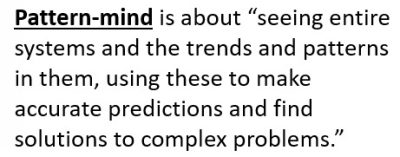
What I am looking for today here now on this blog is a way to use my pattern-mind whilst still meeting the technical specifications and requirements for a successful dissertation outcome. These are the paths and waymarkers I need to find my way to integrate ways of knowing that fall outside the narrow confines and strict rigidities of one singular scientific tradition.
“Whether or not traditional knowledge systems and scientific reasoning are mutually supportive, even contradictory lines of evidence have value. Employing TK-based observations and explanations within multiple working hypotheses ensures consideration of a variety of predictive, interpretive or explanatory possibilities not constrained by Western expectation or logic. And hypotheses incorporating traditional knowledge-based information can lead the way toward unanticipated insights.” (Nicholas, 2018)
It would be easy to politicize this into something outrage inducing in the contemporary trends that inform business models and design decisions on digital platforms commonly labeled ‘social media’ – the internet’s content creation engines have become at once less than human and more than prolific. But that has never been my way. I have a story to tell. I just need to find the opening line.
“As craftspeople began to ally their trades with the liberal arts—and some groups, who increasingly called themselves engineers and architects were quite successful—they met resistance from scholars who denigrated manual craft. Smith returns to a moment when these divisions were not so clear cut, inviting us to reassess how we assign value to different sorts of knowledge. For the artisans and craftspeople Smith studies, knowledge came from bodily experiences and a practical ability to intervene in nature.” (Gurevitch, Boston Review, 22.2.2023)
