
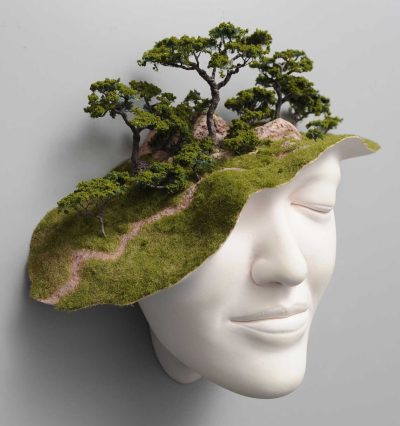
“Knowledge creation is a continuous self-transcending process”
Nonaka, Konno, & Toyama, 2001
My introduction to Yunkaporta’s work led me to dive more deeply into the exploration of thinking about diverse knowledge systems. I can taste unformed thoughts in my mind but do not yet have the words to manifest them. What could help me help them be born? Where and how could I begin to explore other’s words and thinking in order to help me find my way to my own words and thinking? My cognitive labour pangs began last night, and I woke up this morning knowing I needed to begin with looking for thinking about non-verbal ways of knowing and knowledge creation. I struggle with the inarticulate and the unspoken. The sense of knowing that some idea is just around the corner, waiting to be born, but still gestating inarticulately. I will dance today with other’s words and put them together in different ways, as I play around with the inchoate.
“In traditional Western epistemology (the theory of knowledge), knowledge is defined as “justified true belief.” However, this is an absolute, static, and nonhuman view of knowledge and fails to address the relative, dynamic, and humanistic dimensions of knowledge. Knowledge is context-specific and relational. Knowledge is dynamic, as it is dynamically created in social interactions. Knowledge is also humanistic, and it has both an active and a subjective nature. ….we define knowledge as “a dynamic human process of justifying personal belief toward the ‘truth.’” Nonaka, Konno, & Toyama, 2001, pg 14
In my mind’s eye, I can already see a future blogpost that will exist solely to support the title “When Nonaka meets Nakata: Reconciling Conflicts in the Context of Knowledge Generation” – for these words alone, this morning’s work has been fruitful. Let me continue strewing breadcrumbs in my own way as ponder my long silenced voice in academic publication.
“If I hadn’t known better, I would have assumed a global conspiracy to systematically forge an ahistoric and ageographic research perspective. ‘Context’ was grudgingly and apologetically referred to in the limitations of the study.” Jackson in Allen et al., 2022
But knowledge is and isn’t as generalizable and universal as Jackson’s organization and management scholars aspire to be. Not even within their own academy. Nonaka’s legacy is an exemplar, and I will lovingly introduce the concept of ba later on, and see where it takes me. Now however, I’m moved to ask when, where, why, and how did context become such a bad word for the contributions of novel knowledge.
“Shared meaning does not mean that people see things the same way but that they understand each other’s perspectives well enough to accept them” Souba in Allen et al., 2022
Not surprisingly, others who question this separation of “knowledge” contributions from its creation “methodologies” are Indigenous scholars and their collaborators and co-researchers. A methodology and method for research from the Māori paradigm, for example, offers a holistic alternate viewpoint:
“The wānanga process values attunement into phenomena, and as such, challenges the orthodoxies of reductionist, quantitative research. Wānanga traverses time and space and involves both process and a quality of consciousness to bring forth an integrated collective intelligence (Royal, 2011). Through wānanga the distinction between researchers as separate from the field of their focus is dissolved, as it is no longer a study ‘about’ or ‘upon’, but from ‘within’”. Edited text from Paradigm Warriors, 2020, Spiller, Maunganui Wolfgramm, Henry & Pouwhare
There’s nothing like challenging the orthodoxies to bring out the paradigm warrior in all of us. I explore further and discover:
“…our radical ecosystems view is a call … to be paradigm warriors who see beyond the current reality through shafts of enlightenment. They fearlessly pursue enlightenment, often-times amid great struggle and darkness. Paradigm warriors do not settle for an existing reality if it does not serve the wellbeing of people and planet. They push the boundaries to make a change for the better, and in doing so they make difficult decisions. Being a paradigm warrior involves doing battle with oneself to fully realize one’s own potential and to help others achieve theirs.” Spiller et al., 2020
The facetious part of me says well, the call for enlightenment has been seeded in my DNA for centuries of traceable genealogy and very likely for millennia beforehand. You are not born into a Hindu paradigm, no matter how ignorant of it you may be, without absorbing through the very process of immersion (Nonaka’s words on ba is calling loudly now) the idea that one’s life from birth is to step on to the path of lived experience whose end goal is enlightenment. Thoughts on indigenous ways of knowing and their similarities tumble through my mind as I continue to allow the percolations their necessary time and space.
“… ba can be thought of as a shared space for emerging relationships. This space can be physical, virtual, mental (eg. shared experiences, ideas, ideals), or any combination of them. What differentiates ba from ordinary human interaction is the concept of knowledge creation…. Ba may also be thought of as the recognition of the self in all. … ba is a context which harbours meaning….Knowledge is embedded in ba (in these shared spaces), where it is then acquired through one’s own experience or reflections on the experiences of others. …knowledge resides in ba. It is intangible.” Nonaka & Konno, 1998
Knowledge, thus, resides in a context, which harbours meaning.
“Knowledge is created through interactions between human agency and social structures.” Nonaka & Toyama, 2003
Foley’s notes on putting Indigenous standpoint theory into practice includes the following point:
“The Indigenous epistemological approaches in an Indigenous standpoint enable knowledge to be recorded for the community, not the academy. The participants are the owners of the knowledge, not the researcher.” Foley, 2004
Thus, knowledge created, belongs to, and must serve the needs of those who participate in the creation of knowledge (see Nonaka and Foley together) rather than benefit only the observer/researcher/publication author who adopts the idealized stance of detachment and objectivity as espoused in the traditions of the academy. Nonaka and his colleagues may not be categorized as Indigenous scholars and their context of Japan is ironically the only far eastern country counted in the “the West” but this does not diminish the value of their contribution drawn from their own indigenous cultural standpoint.
“Knowledge needs a physical context to be created. As stated previously, knowledge is context-specific, as it depends on particular time and space (Hayek, 1945). Knowledge does not just exist in one’s cognition. Rather, it is created in situated action (Suchman, 1987)… the conceptualization of ba is extended to cover the interdependent interaction between agents and structures. Thus, ba is a continuously created generative mechanism that explains the potentialities and tendencies that either hinder or stimulate knowledge creative activities. Therefore, the knowledge-creating process is necessarily context-specific in terms of time, space, and relationship with others.” Nonaka & Toyama, 2003
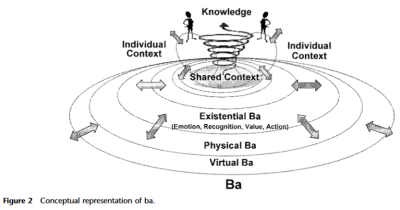
Ba is an existential place where participants share their contexts and create new meanings through interactions. Participants of ba bring in their own contexts, and through interactions with others and the environment, the contexts of ba, participants, and the environment change (see Fig 2). Nonaka & Toyama, 2003
Rigney’s (1999) Indigenist Research cited by Foley (2019):
“This approach rejects the dehumanizing characterization of Indigenous peoples as the oppressed victims in need of charity by challenging the power and control that traditional research has had on knowledge over the ‘other'”(Rigney 1997).
One can do this, as an ‘other’, without having to be Indigenous. And, one can take Nonaka’s path, which weaves different philosophies and, even, seemingly incommensurable knowledge systems seamlessly together.
“To participate in a ba means to get involved and transcend one’s own limited perspective or boundary. this exploration is necessary in order to profit from the “magic synthesis” of rationality and intuition that produces creativity.” Nonaka & Konno, 1998
What this reading and thinking and citing is showing me today is that the dominant narrative of knowledge creation and dissemination is a permeable space and open, ironically, to novel approaches and ideas. At this moment of time in history, the western scientific model of knowledge generation and its underlying knowledge system is in a particularly plastic mode of being, ready to receive challenges to its own recognized limitations and rigidities as scholars look inward not only for meaning and purpose, but also outward to the needs of the planetary future.
“We need to stop perpetuating a science that removes us from our environment and communities and heal ourselves from the illusions of this so-called rupture.” Spiller in Allen et al., 2022
Where I go with all of this, and whether my words will be born, I cannot tell. This conversation will continue.
