
“… it is often far more time-consuming to attempt to describe hand-work in words than simply to demonstrate it.” (Smith, 2022)
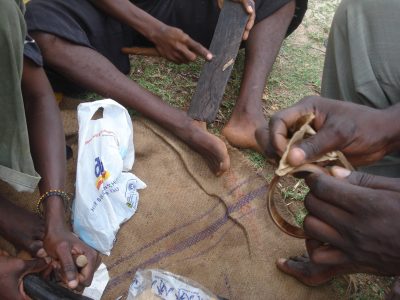
“…finally, and most significantly,
ifwe conceiveofskills as arising at the interface of the human senses and human body with the natural environment…” (Smith, 2022)
“Thinking with your hands” – as a phrase – captured my imagination this morning as I read snippets of Pamela Smith’s book linked to above and it opened the door to looking for the words which I was seeking last night. I have found a means to weave together three different strands of knowledge – the informal economic system and its socio-economic practices; the ‘thinking with your hands’ that is part and parcel of artisanal craftsmanship, model making, prototyping, and sand talk; and, the lived experience of a third culture kid/global nomad, for whom cultural identity is a life long project of exploration and discovery rooted in relationships and intangible ‘places’ rather than geographies and cultures.
Indigenous Knowledge systems are regarded as complex adaptive systems (Rose, 2005) and I have always conceptualized and envisioned the informal trade ecosystem as a complex, adaptive system (see Bhan & Gajera, 2016; 2018). This allows me to take the very short next step of conceptualizing the informal trade ecosystem (which includes the making and doing of artisans and farmers in addition to traders – see Kinyanjui, 2019) as an indigenous knowledge system in own right, in this case situated in Kenya and the East African Community where we have traced and documented the rural/urban linkages and the flows of knowledge, information, goods, and people in great depth and detail. I remove the capital letter I from indigenous in this case because navigating economic informality in a particular geography comprises of local and traditional knowledges and is indigenous to the region, having existed for centuries prior to the imposition of the global formal economic system derived from its roots in western knowledge systems and the colonial enterprise. The situation is no different from the continent known as Australia given the issues surrounding the settler economy and the ‘native’ entrepreneur (still reading Foley).
“There are multiple ways of seeing, understanding and being in the world. The entrenchment of western knowledges, paradigms and the concomitant centrality of non-pluralistic logics have been ideologically, conceptually and intellectually privileged to make sense of the world and order reality. this self-referent world-view recircuits a ‘natural’ authority to diminish or exclude other forms of knowledge, its disseminations, expression, credibility or indeed existence. To ‘make room’ for diverse knowledges creates enormous tensions and challenges.” (Fletcher & Chealuck, 2021)
Those of us who grew up outside of our passport countries navigating multiple cultures during our developmental years view the world from a multiplistic perspective that viscerally understands that there are multiple ways of seeing, understanding and being in the world. We simply lack the words with which to articulate this knowledge, as a marginalized cohort on the fringes of our current societies of residence and/or adoption. Inasmuch as Yunkaporta’s thinking tools offer a whole new way to approach knowledge creation and knowledge systems, they also offer a means for the TCK/global nomad child to find the words to articulate the human in all of us – our creative spark, our making of tools, our recognition of a plurality of knowledges (Visvanathan’s cognitive justice) – that we’ve seen and understood for the most part before we may even enter our teenage years. This standpoint can be complex and complicated as a prism with an infinite number of facets or as simple as acknowledging our common humanity. Maybe the human-centered point of view is no more simply for the sciences of the artificial but a meta-standpoint that transgresses the artificial boundaries constructed by Linnaean classifications of externalities such as the amount of melanin or the texture of the hair to arrive at the core – the DNA, unironically speaking – that is the mother of us all, Mitochondrial Eve herself.
What would Mitochondrial Eve’s standpoint theory look like for understanding how her children learn and pass on their learning to their children’s children?
Anyway, back to the interface of the human senses and body and the natural environment, conceptualized as practical skills for making by Pamela Smith (2022) can also be perceived as a place where pattern-mind and story-mind come together in the workshop as dreaming-mind when using Yunkaporta’s thinking tools, as he himself demonstrates though not articulates when he describes the process of creating the book’s table of contents as an intricate woodcarving, in order to give his thoughts meaning and form, when manifested tangibly.
Thinking with your hands, indeed.
