
As promised at the end of the previous post which introduced the background to this interwoven framework where I bring together the knowledge work of Indigenous scholars and scientists like Robin Wall Kimmerer, Martin Nakata, and Tyson Yunkaporta into my visualization together with my contributions (in purple) drawn from my own creative practice-based research. The most difficult part was working within the limitations and constraints of the English language in order to weave all these ways of knowing and thinking together. This is a challenge that all the knowledge keepers I’ve been reading have faced in their own work as well. One can say it is a reflection of the way the knowledge systems are currently set up for sharing and learning across time and place.
I have attempted to design the platform with the spirit of Nakata’s cultural interface theory (1997; 2007) in mind so that it acts as a guide for us to look for points of reconciliation as a means to creatively blend multiple knowledge systems. It is not “the” answer nor does it provide answers for the knowledge weaving that must be done by each team or group planning to work with other knowledge systems. Instead, it offers a means to gain clarity on one’s own blind spots by mapping the underlying structure of knowledge systems onto means of gathering evidence and means of interpretation.
First, Ways of Knowing provides the underlying structure for the way knowledge systems work by visualizing Kimmerer’s words below in the form of a 2×2 position map.
“In indigenous ways of knowing, we say that a thing cannot be understood until it is known by all four aspects of our being: mind, body, emotion, and spirit. The scientific way of knowing relies only on empirical information from the world, gathered by body and interpreted by mind. In order to tell the mosses’ story I need both approaches, objective and subjective.” (Kimmerer, Gathering Moss, 2021)
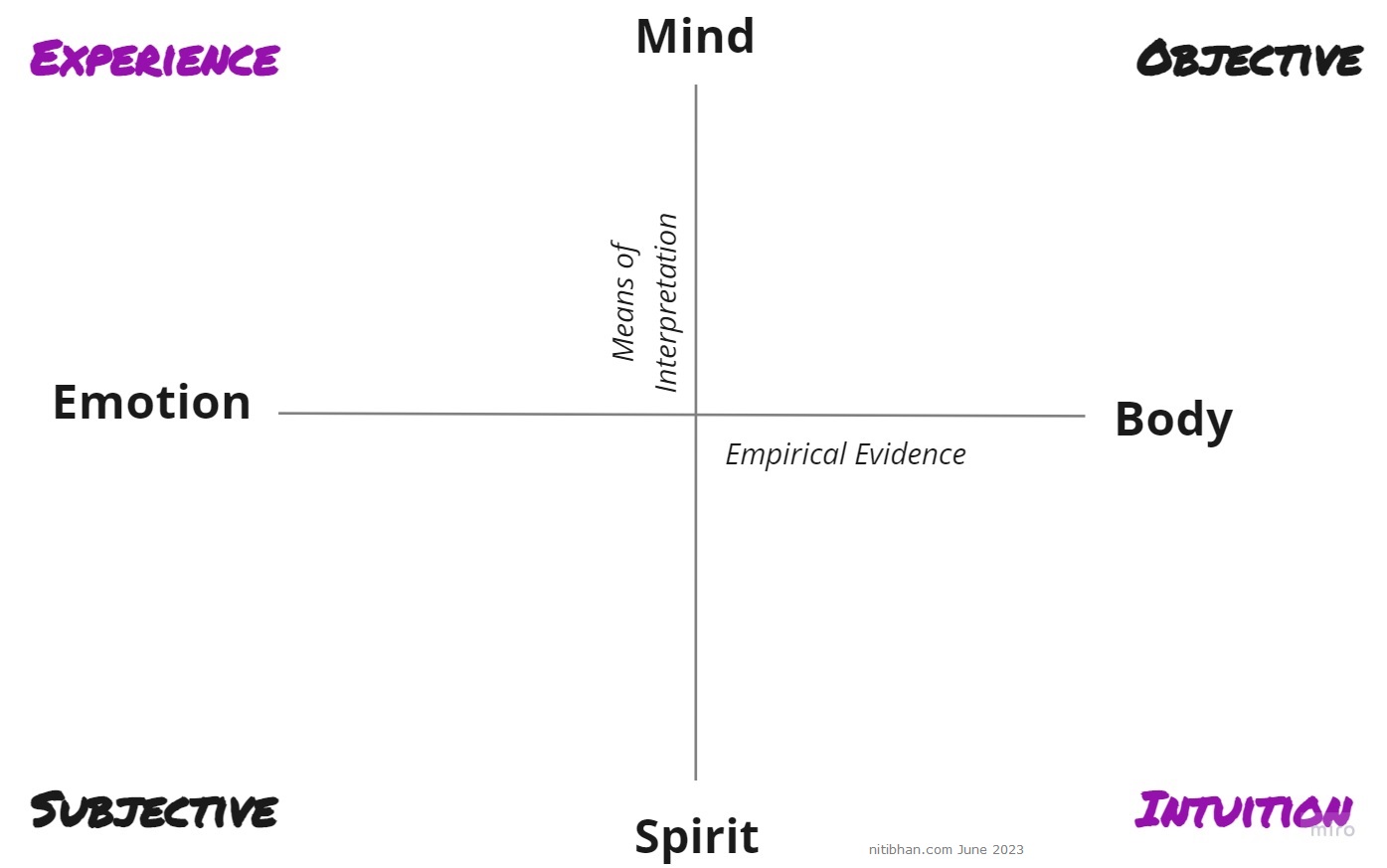
We can see the gaps in the quadrants once her positioning of Objective and Subjective are filled. Experience and Intuition are two ways of knowing that seem to fit. Experience fits between Emotion as the empirical evidence gathering mechanism and Mind as the means of interpretation. However, the caveat remains that Experience accrued over time is also a way of knowing that could take the form of muscle memory – driving a car, for instance – or emotion. Experience is however Subjective and even if its a practical skill, one ‘feels experienced’ thus one feels confident of one’s skills and capacities. The empirical evidence for Experience is thus gathered through Emotion. Similarly, Intuition feels just right as a 6th sense between Body and Spirit. Intuition is not considered to be interpreted by mind. And, though it is commonly referred to as a feeling – it is most often called a gut hunch, not an emotion experienced like anger or joy. Thus it can be said to be a form of embodied data.
In looking for points of overlap and thus reconciliation (Nakata’s theory of cultural interface), I briefly introduce the metaphors of day science and night science attributed to Nobel prize winning French scientist Francois Jacob.
“Our breakthrough was the result of “night science”: a stumbling, wandering exploration of the natural world that relies on intuition as much as it does on the cold, orderly logic of “day science.” In today’s vastly expanded scientific enterprise, obsessed with impact factors and competition, we will need much more night science to unveil the many mysteries that remain about the workings of organisms.” (F. Jacob, The Statue Within: An Autobiography, 1988)
and
“[Night science] is a sort of workshop of the possible where the future building materials of science are made…Where thought proceeds along sinuous paths, winding streets, most often blind alleys…. What guides the mind, then, is not logic. It is instinct, intuition.” (Gaver et al., 2022 attributed to Jacob, 1966)
It is difficult to overlook the similarities between Jacob’s words and Kimmerer’s, although their reasons for their ways of approaching knowing and knowledge creation – natural scientists both – may differ. Further, Jacob’s description of night science guided by intuition underscores my addition of Intuition to the diagram. One’s intuitive perception is only said to increase with one’s experience. The addition of intuitive perception in transformative research has also been brought to notice by Donna Mertens (2017).
Second, Ways of Thinking is a multi-layered approach for integrating creative practices into our knowledge weaving work. It offers a framework for putting cognitive justice into practice. It is designed to provide a shared space where a plurality of ways of knowing and many different ways of thinking can come together in an active ‘ecology of knowledges’ and acts as a cultural interface.
Cognitive justice, a concept originating in decolonial thought, encompasses not only the right of different practices to co-exist, but entails an active engagement across their knowledge-systems (Visvanathan, 2005; 2009). […] In practice, cognitive justice is given shape through an ‘ecology of knowledges’: an active dialogue between different forms of knowledges and practices, both scientific and nonscientific (Santos, 2014). It involves rethinking the way in which knowledge emerges in modern science, where one side produces and the other passively consumes. It challenges the ‘monocultures of the mind’ (Shiva, 1993) and calls out the external limits of modern science, i.e. dimensions rendered invisible by reductionist epistemologies (Santos, 2007, 2014). (Coolsaet, 2016)
I use 5 minds from Yunkaporta’s Sand Talk and the addition of Vitality inspired by The Nutmeg’s Curse by Amitav Ghosh in the form sticky notes placed in different blind spots that may occur if we’re bounded by the confines of the western knowledge system (WKS) and the scientific method.
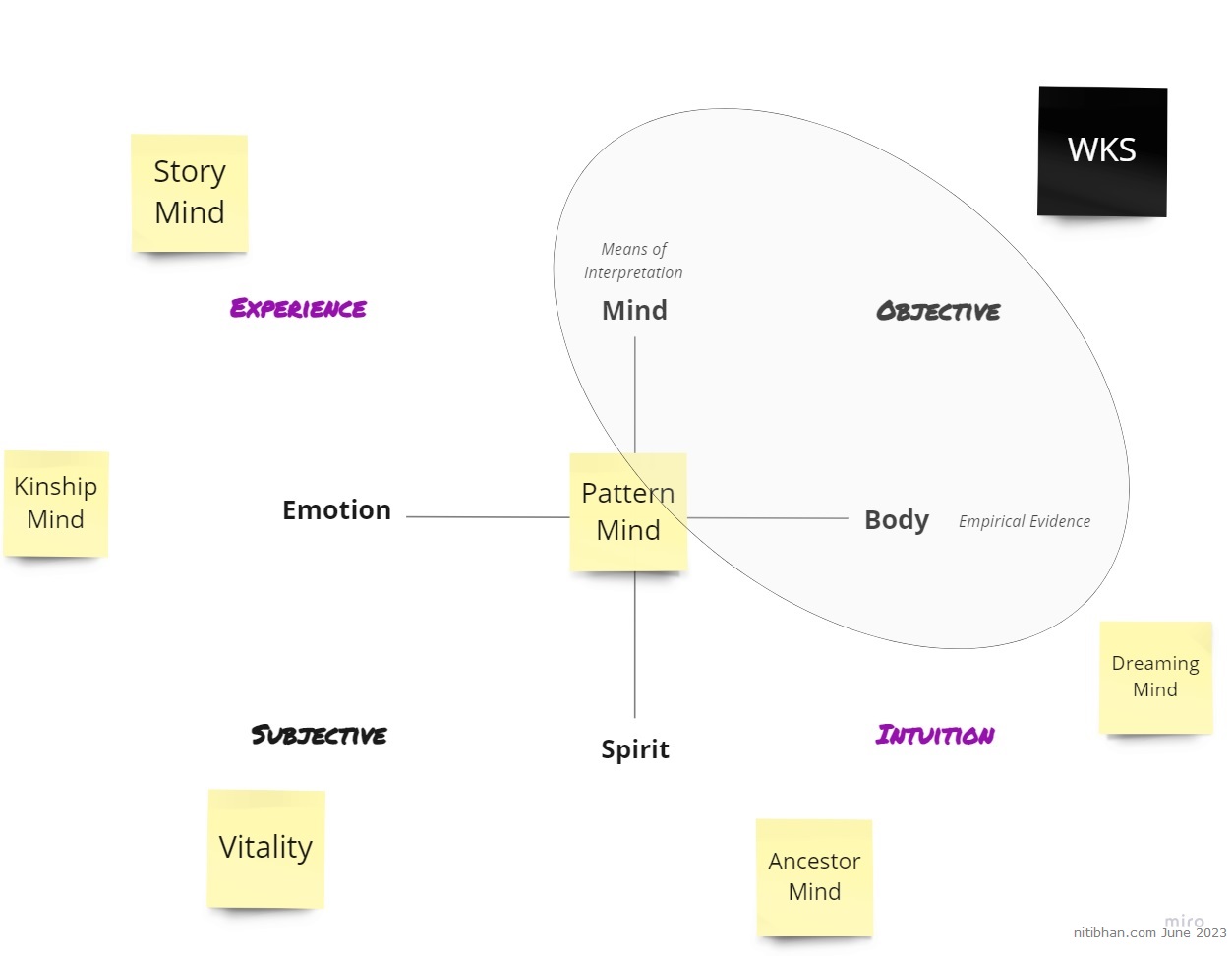
Vitality – a word choice still under discussion with my team on Miro – is meant to reflect the loss of knowing we live in a sentient world. “Nature” was rendered inert and lifeless and framed as a resource to be exploited, Ghosh describes to us through the work of Francis Bacon, as he outlines the story of how rational science came to be deeply intertwined with beliefs of which living beings are worthy of life and which are to be exploited as beasts of burden. Denaturing nature is a loss keenly felt today, particularly where WKS modes of thinking are the only recognized ways of knowing.
At this point, I simply introduce these sticky notes as inspiration for practical exercises to help us explore the gaps in ways of knowing. Think of this creative activity as an exercise in cognitive preparedness in advance of any transdisciplinary knowledge weaving work to be done in the real world. Through its clear identification of possible blind spots, it can help guide project and research design and planning. This ‘ecology of knowledges’ platform also provides a foundation for future development of holistic knowledge practices inspired by ancient ways of thinking, being, and doing as well the as the practical skills of making. Get in touch with me for an exploratory online workshop on how to use the platform as a diagnostic tool and as inspiration for creative practices to expand and enhance ways of thinking and knowing.
