
Given the legacy of Steve Jobs – unavoidable in Apple’s case – and his reputation for visionary design leadership; it is inevitable that when a product such as the Vision Pro comes out in 2023 one is moved to ask:
a) Does Apple truly see this category as a big enough opportunity space – of course 3500$+ tax is profitable enough even if its just a niche within the world’s top 5% of the population – to invest in a full scale product development strategy and production planning process?
Or
b) Was it announced because they just needed a new piece of hardware in their larger product development cyclical pattern and not just another iteration or extension and this was already in the path to market works before the metaverse crashed and was burnt into oblivion by the AI stuff?
Unlike digital design, the investments required for hardware are far less flexible for design iterations and changes before, during, and after the actual public announcement and launch. This difference in product and production planning could explain why few of the digital tech giants have ever succeeded in following through with their hardware strategies successfully after the first flush of PR related hype dies down.
Apple, unlike the Metas, Googles, or Microsofts it tends to be lumped together with due to geographic proximity and its operating systems, has always designed and produced its own hardware from the very beginning. Software and hardware are two halves of the whole, and the service and business model wrap it up together.
Its been a design strategy case study since the iPod disrupted the market with its 99 cent songs seamlessly accessible from iTunes – a holistic product/service/business model ecosystem. Design case studies – often used in classroom lectures – are rarely written up for publication. But if you can get your hands on it, Larry Keeley (co-founder, Doblin) had a great one he used for our Design Planning class at ID-IIT, Chicago.
Anyway, my point is that Apple should be, if it is not, cognizant of the entire system of decisions, moves, investments, and resources required to get a luxury piece of hardware into the consumer’s hands. And it is this sunk cost that I am thinking about when I ask the two questions above.

The illustrations are from Distinguished Professor Dr. Jack M. Wilson’s Case Study on Apple’s Supply Chain – the supply chain represents an ecosystem in its own right – one that must be mobilized in advance of any public announcements, or at least one should have done so, given the number of stories we hear in the press about products “launched” but never reach a shop or a customer’s hands.
It was as global as this 10 years ago, though the geopolitical impacts of recent years would have made relevant and appropriate changes to the choice of jurisdictions in response to changes in policies and politics. This is what a multinational corporation (MNC) looks like in today’s world. Umpteen different moving parts must come together in harmony for the successful and seamless follow-through from the day an idea was sketched out to the day it was launched in the consumer market for purchase and profits, for all concerned.
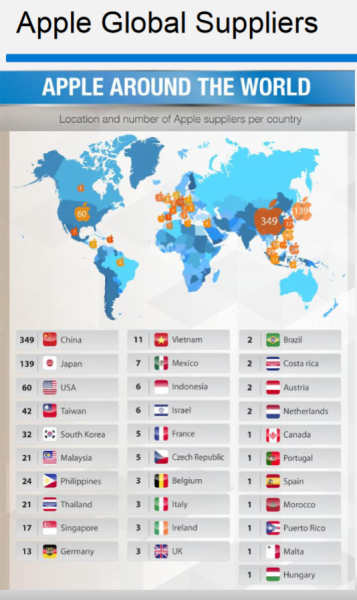
This is why I ask what moved this decision to launch this product in the market in today’s world. Not only are numerous elements of the supply chain ecosystem under pressure from a wide variety of factors ranging from conflict minerals supplies to EU energy consumption regulations but the range of geographies accessible for supplier negotiations has become a moving target due to ever-changing trade laws.
Can this kind of decision today even be called “visionary design leadership” ?
And, can “visionary design leadership” simply stop when the most beautiful concept design has been selected for launch without due consideration of all the PESTE factors in force in our turbulent times (aka the branded polycrisis)? I don’t think Steve Jobs ever did that, although it was the beautiful design that captured everyone’s attention when the category-creators were launched in their day.
That is, today’s reflection on Apple’s actions helps us reframe an important question on design leadership more concisely:
Is design leadership simply a matter of competitive artefact design or also a matter of choosing the direction of product development, for ex. “in this world today, is this the right product to be focusing on?”
A question that will not be answerable with just one post.
